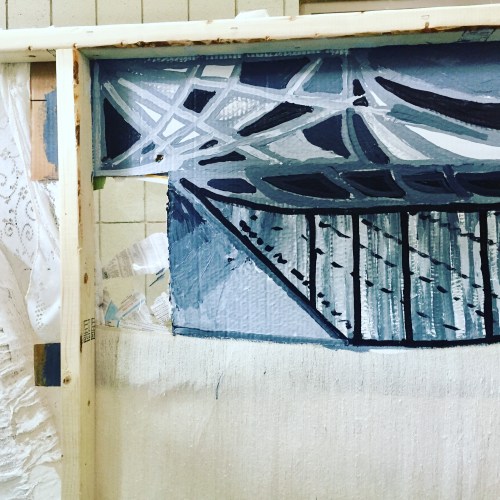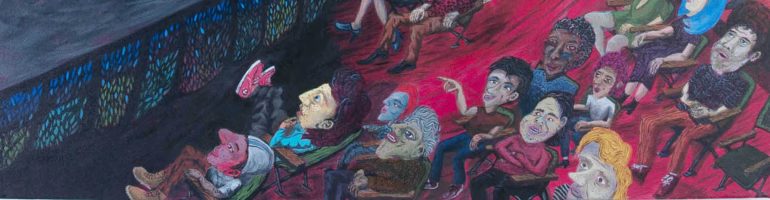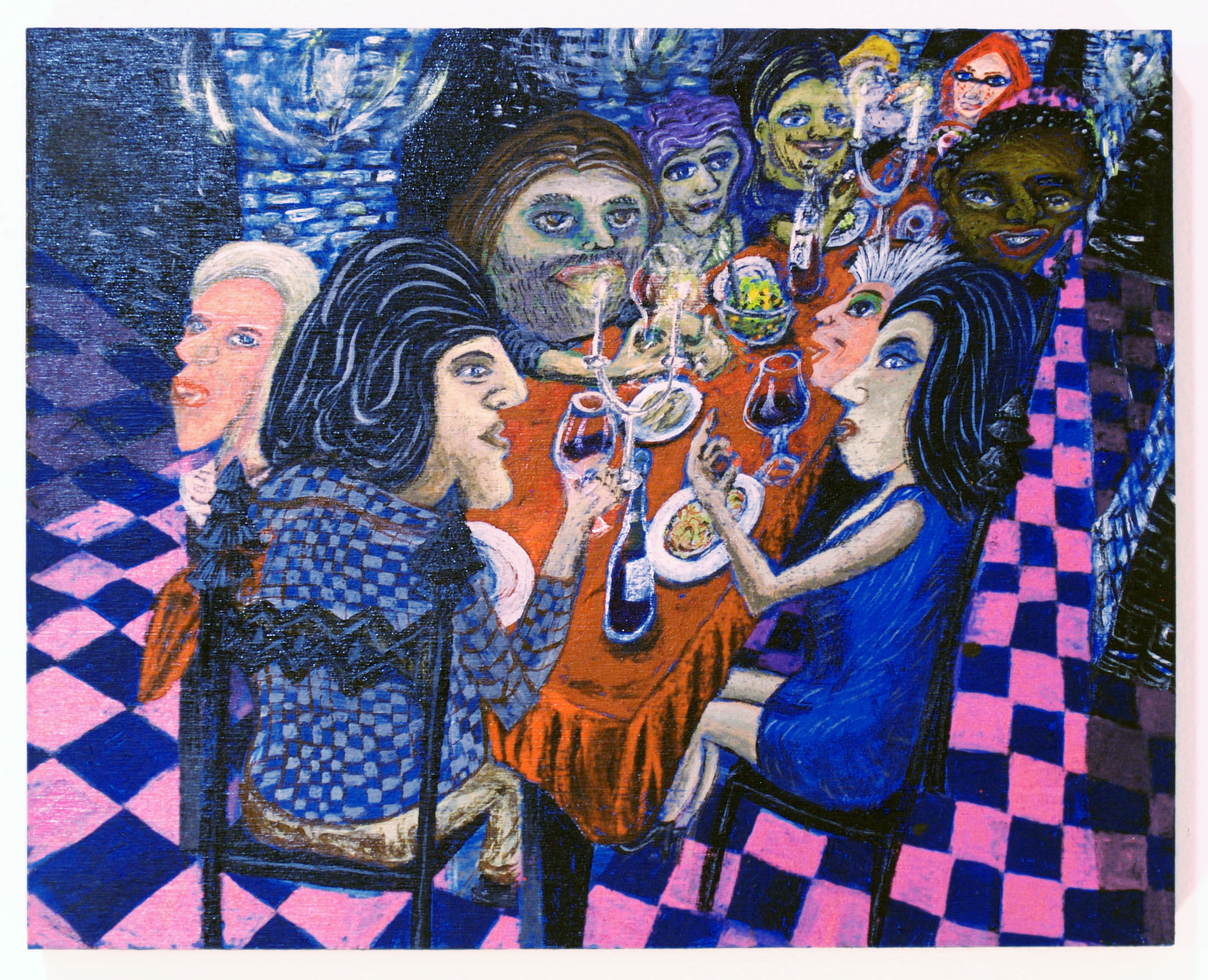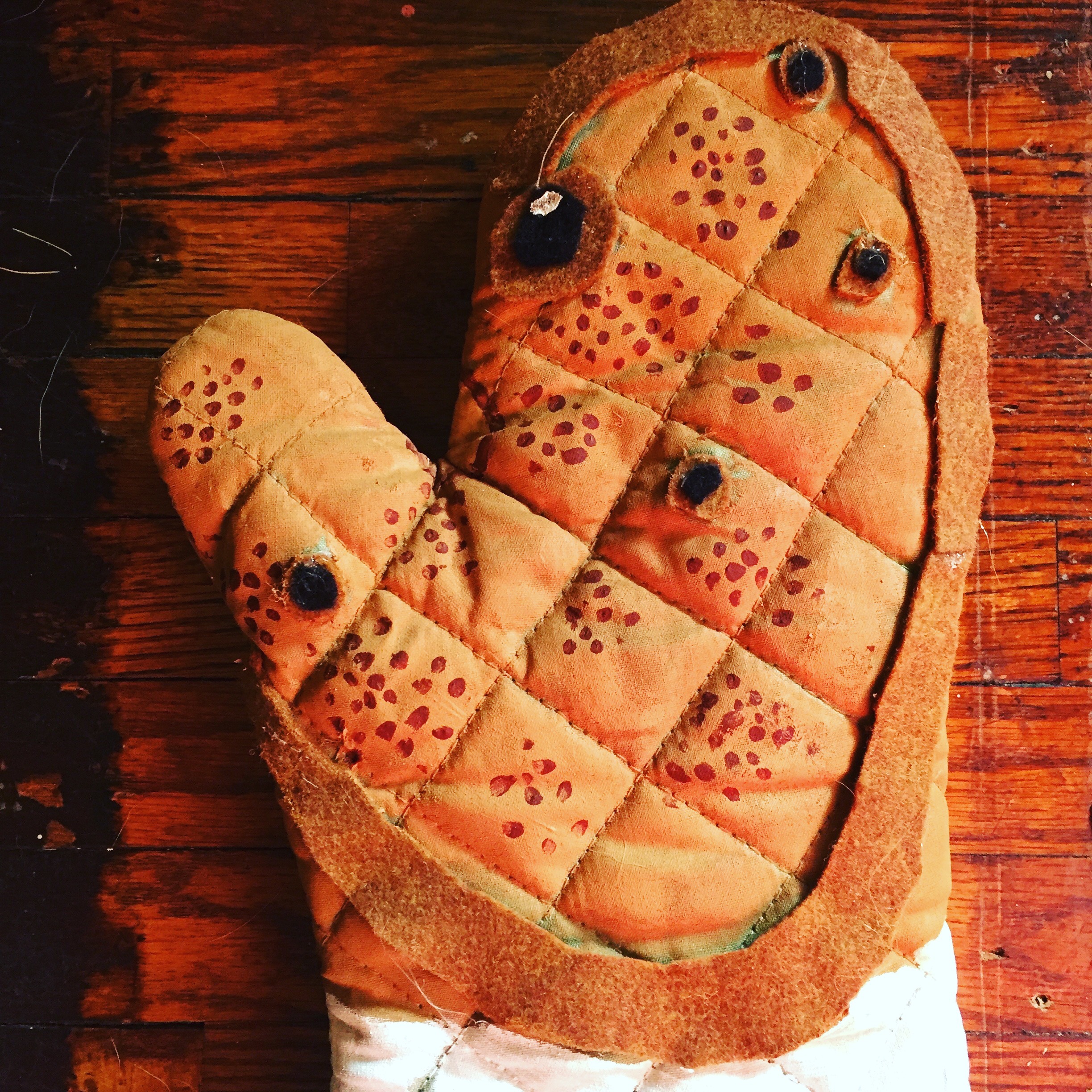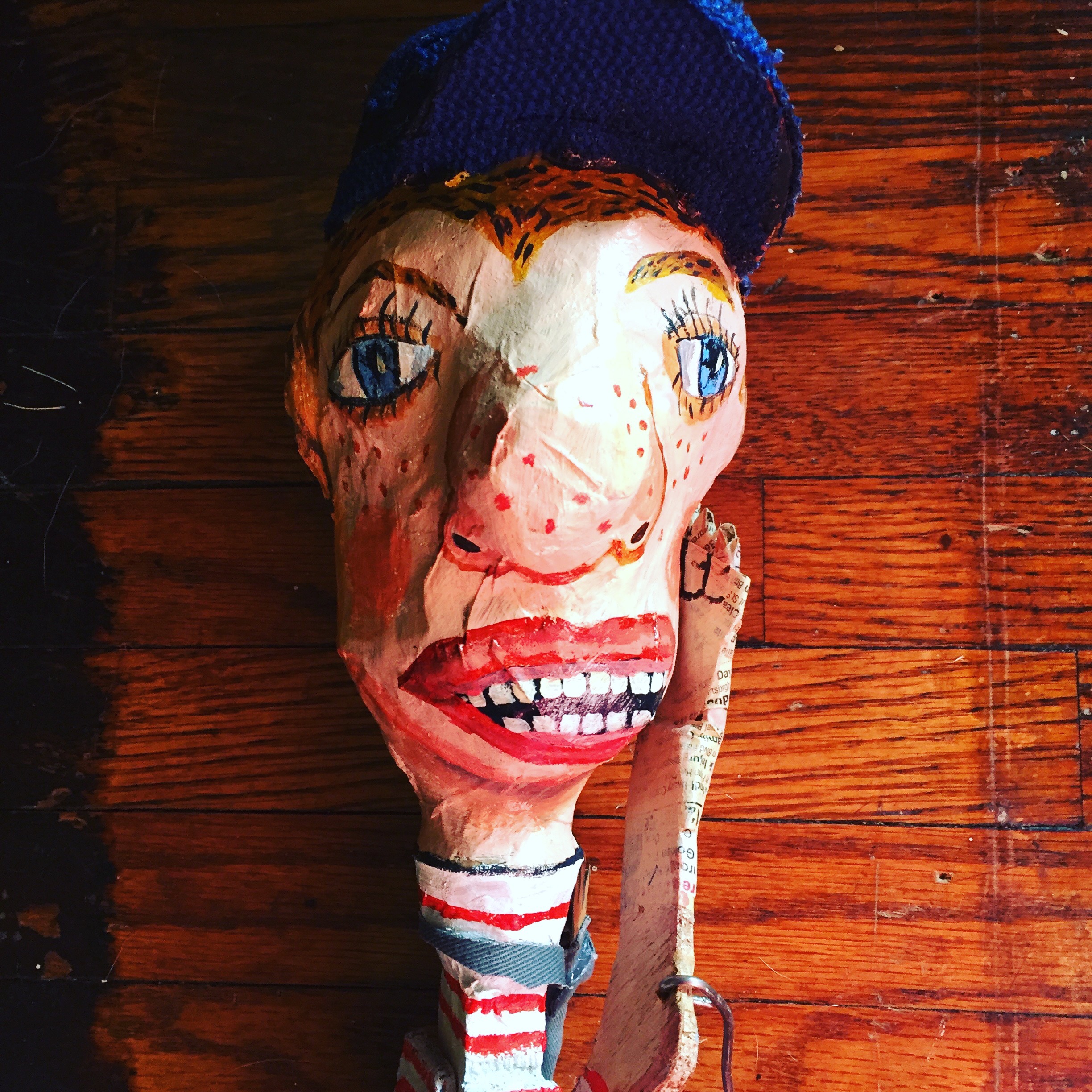
I’ve recently completed a new body of works for a show at James Gallery, Pittsburgh, PA. Pretty Ugly, which opens Friday, September 20th, features a group of artists practicing outsider art, folk art and eclectic approaches to depicting the figure.
Filed under Uncategorized
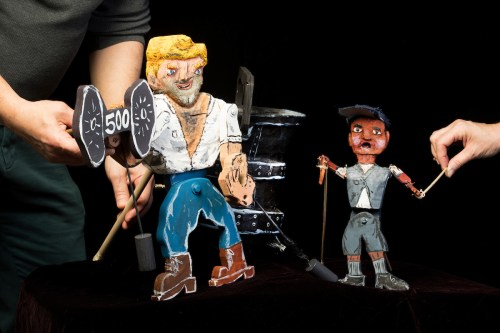
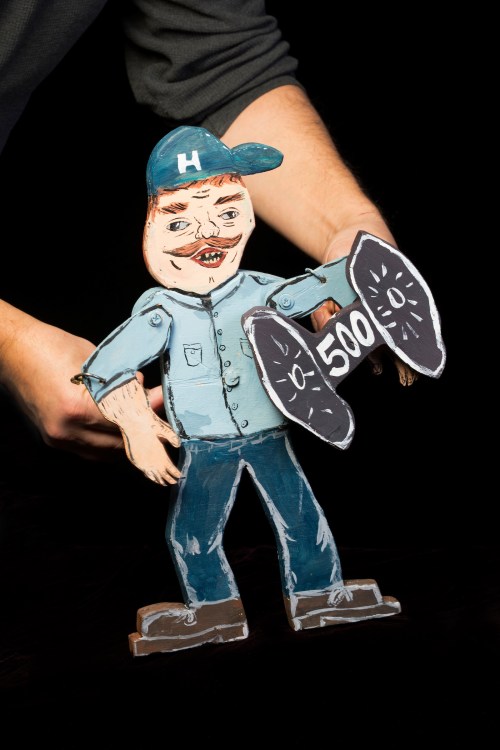
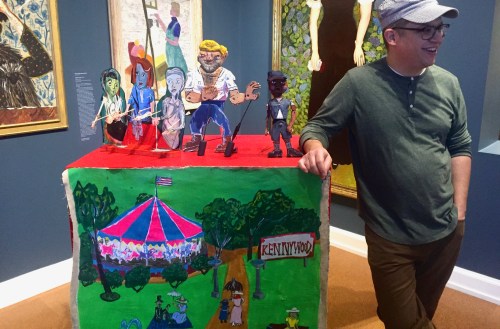
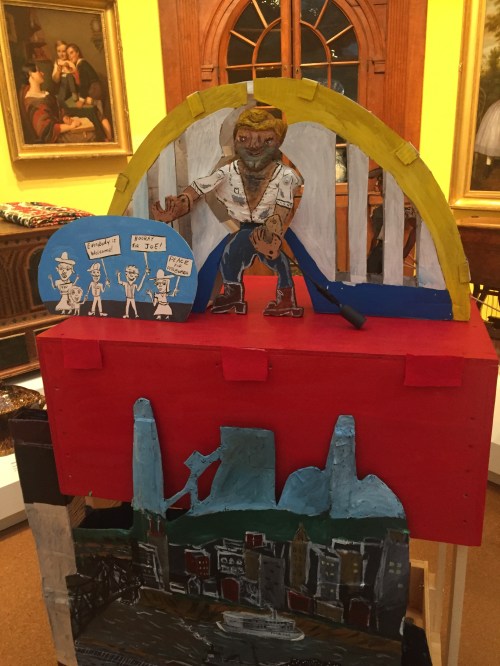
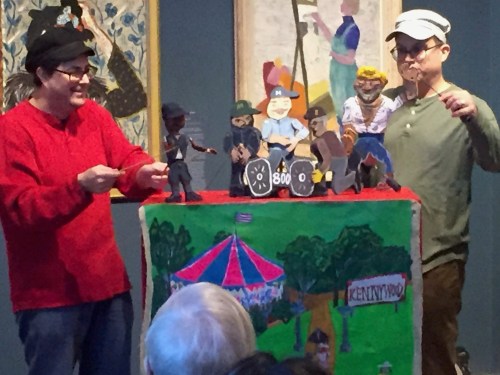
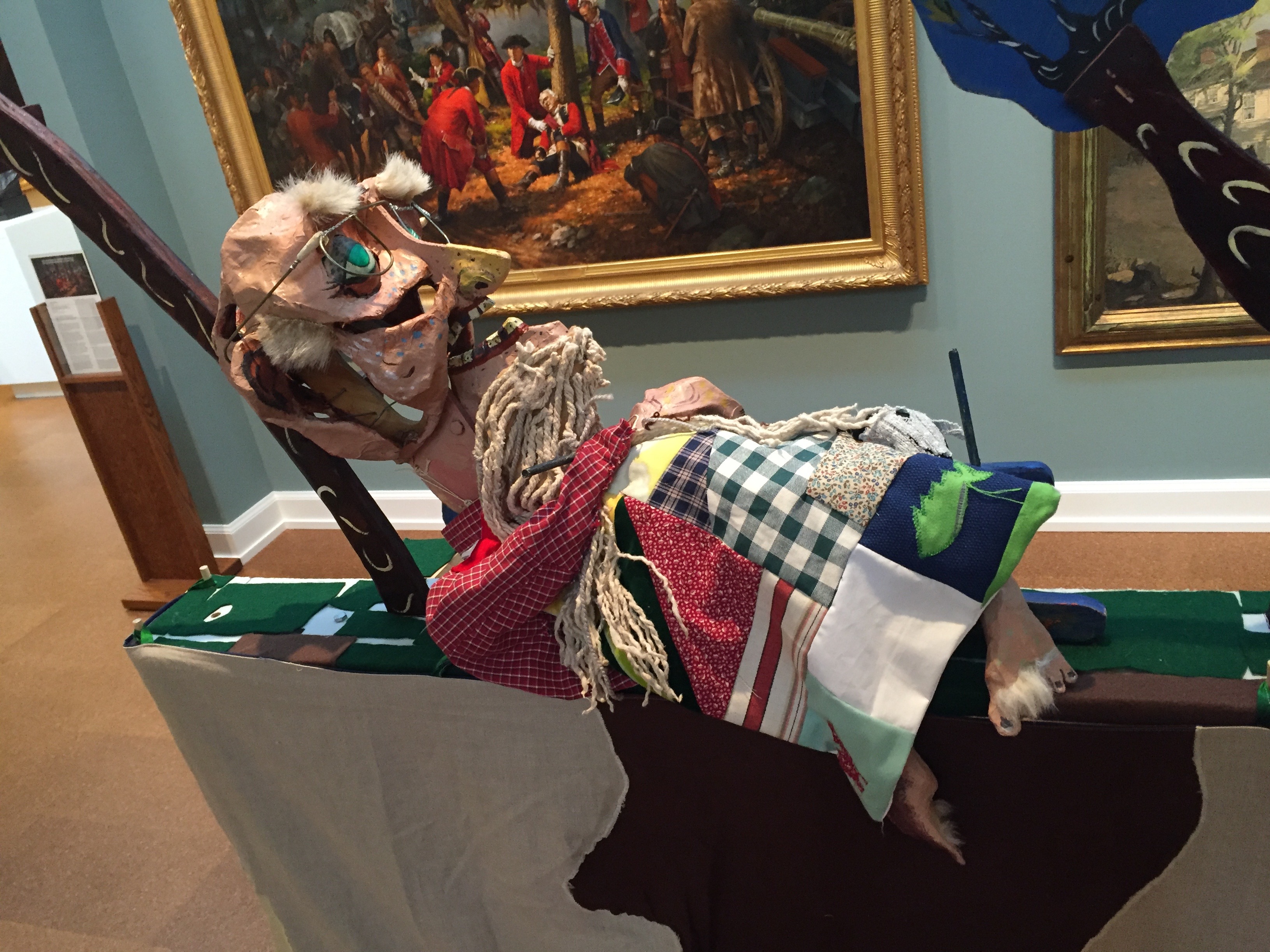
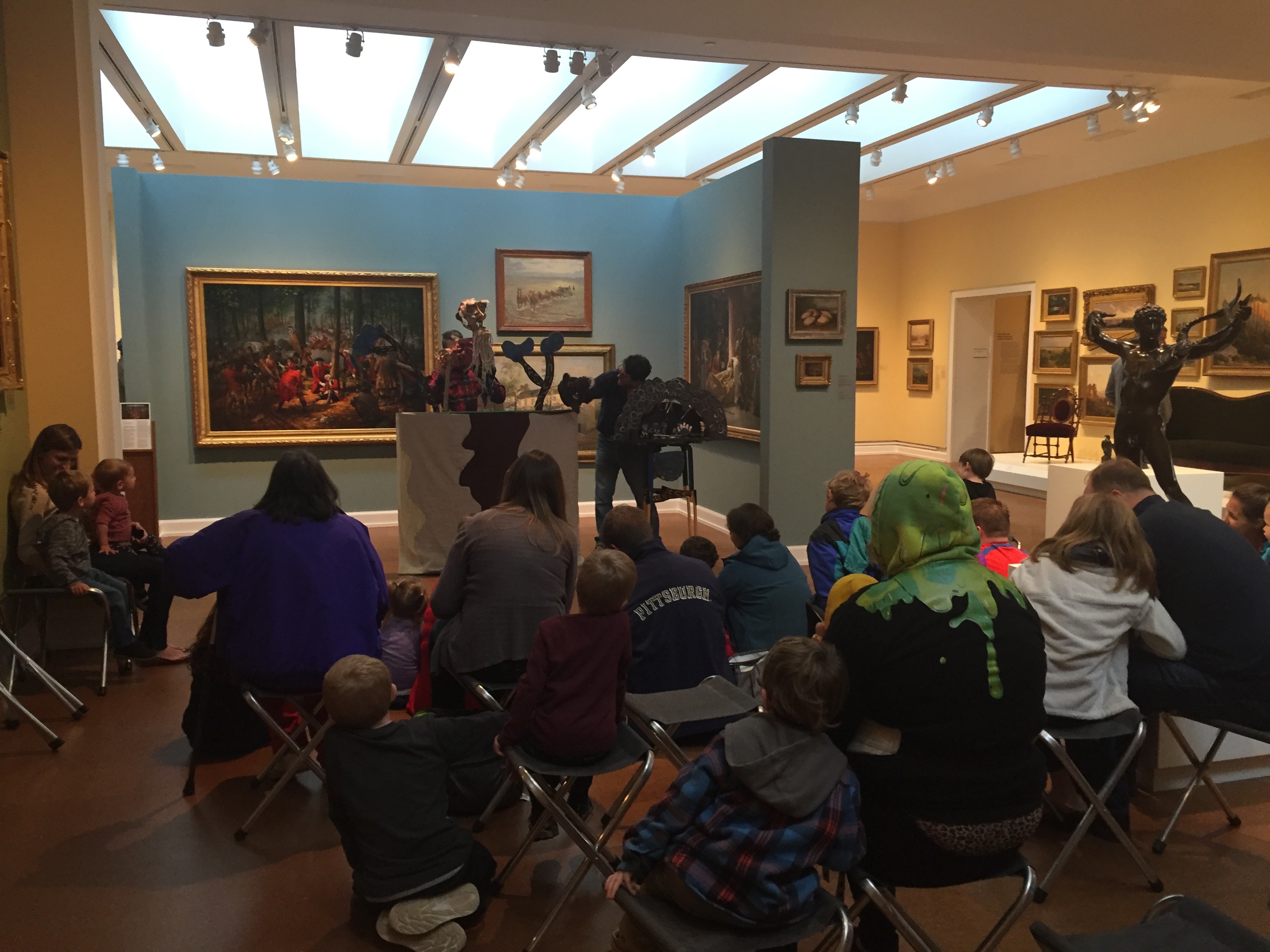
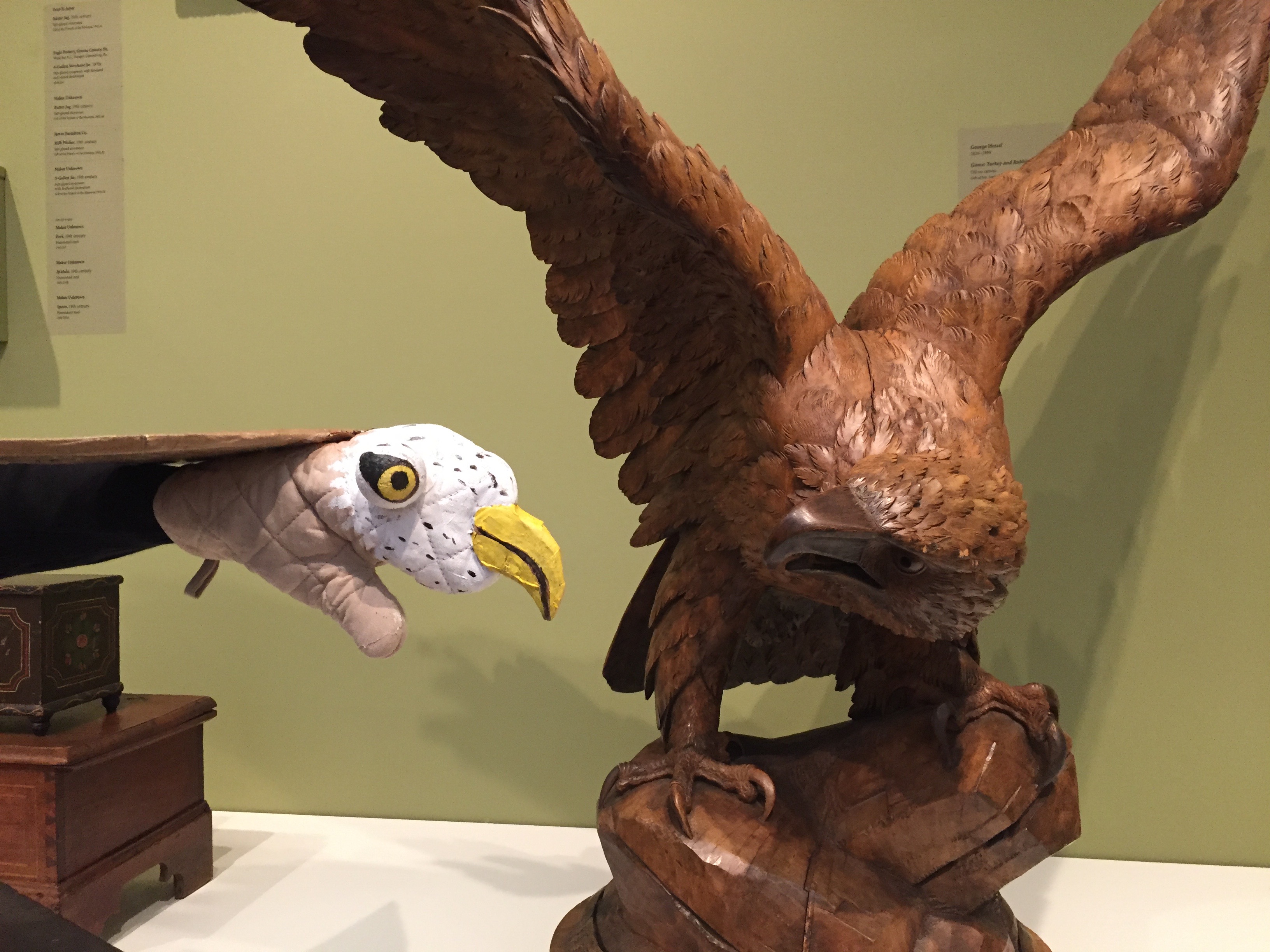
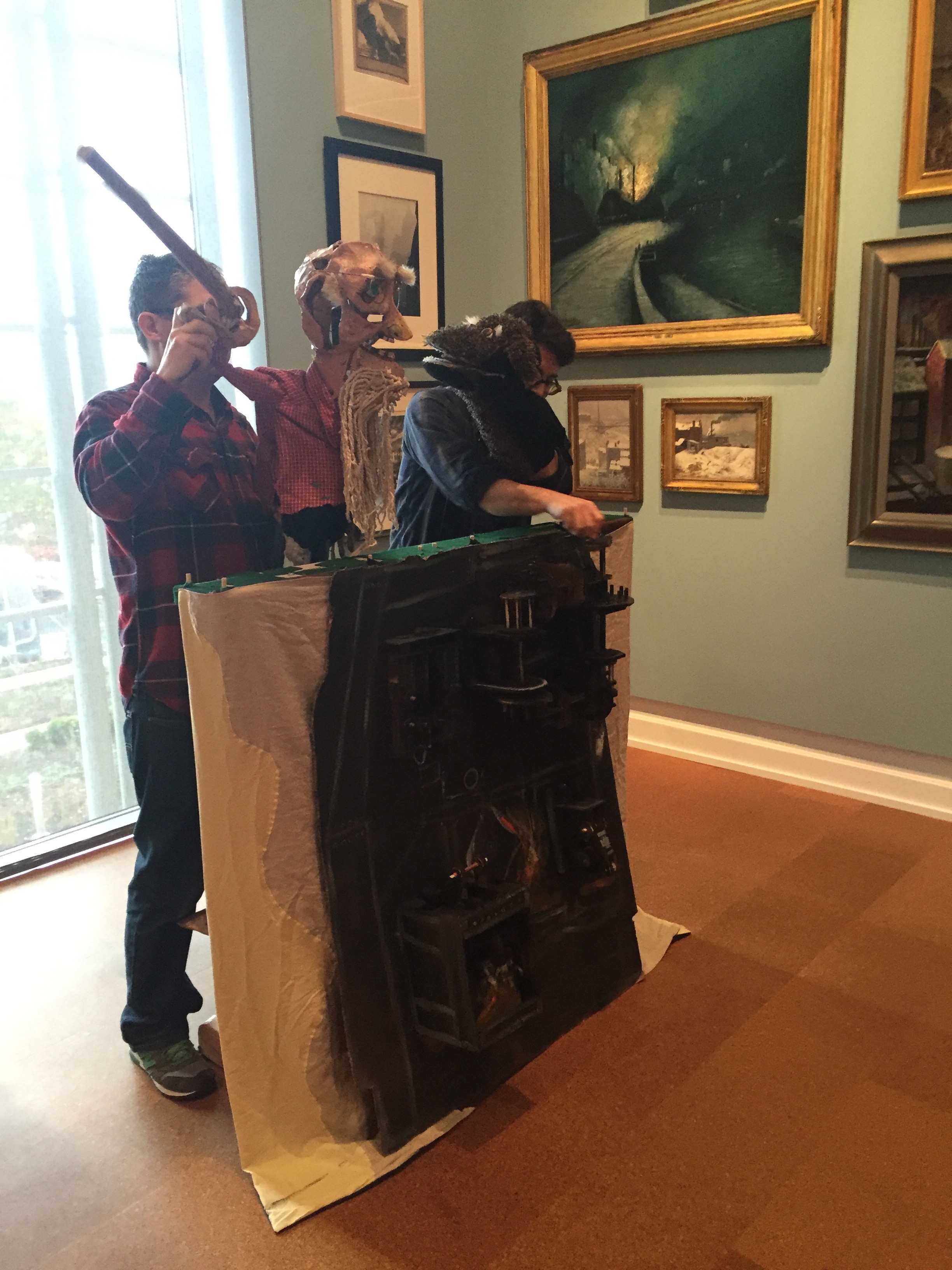
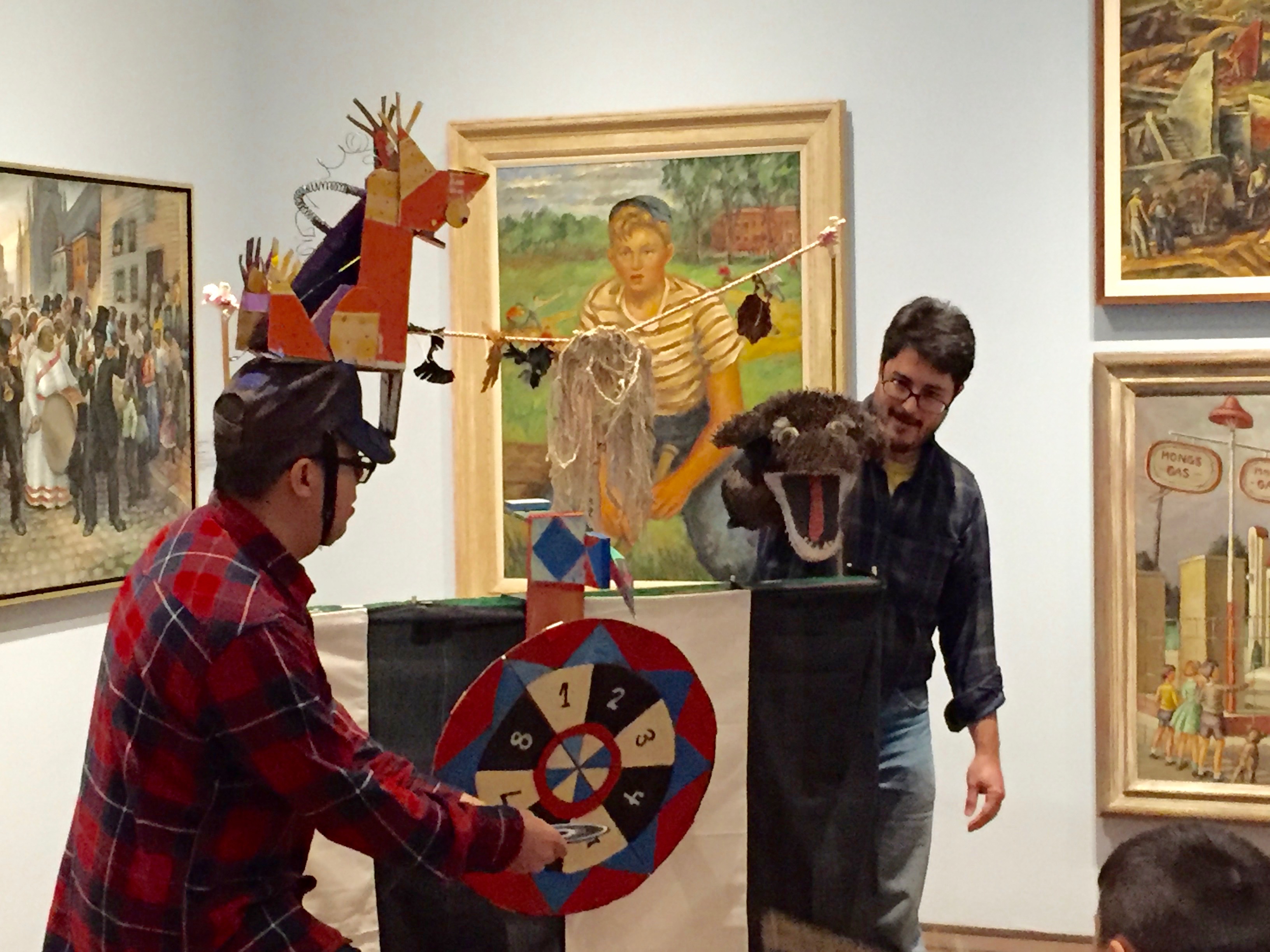
It’s been a while since I’ve done regular blog posts. Here are some images from a November 2018 puppet show at the Westmoreland Museum of American Art. Mike Cuccaro and I developed a series of shows about the Pittsburgh folk legend, Joe Magarac. We wrote a script, crafted puppets and then built three shows to perform in various galleries of the museum. We adapted a variety of Magarac legends, weaving in content from the works in the Westmoreland collection. The shows were played throughout the day on the museum’s Family Day.

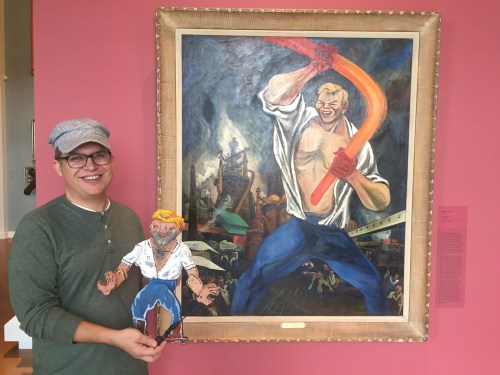
Legendary steel man Joe Magarac could bend hot steel with his hands.

Joe Magarac and Newsie Ned. Photo by Larry Rippel.

Mike Cuccaro sings the Joe Magarac Song to open Part II of our show. Joe works 24 hours a day, doing shifts in the Homestead, Monessen and Braddock steel mills.

Homestead Harry, lifting a 500 pound dolly bar. Photo by Larry Rippel.

Getting ready to start Part I of the puppet show. A wheeled stage made it easy to move the show to various galleries of the museum.

In the final act of the production, Joe Magarac falls into a vat of hot steel, and is then poured into steel beams used for the creation of a new bridge. In this scene Joe has become the bridge.

Part I, Newsie Ned comments on a contest of competing steel workers at their annual Kennywood Picnic.
Filed under Uncategorized
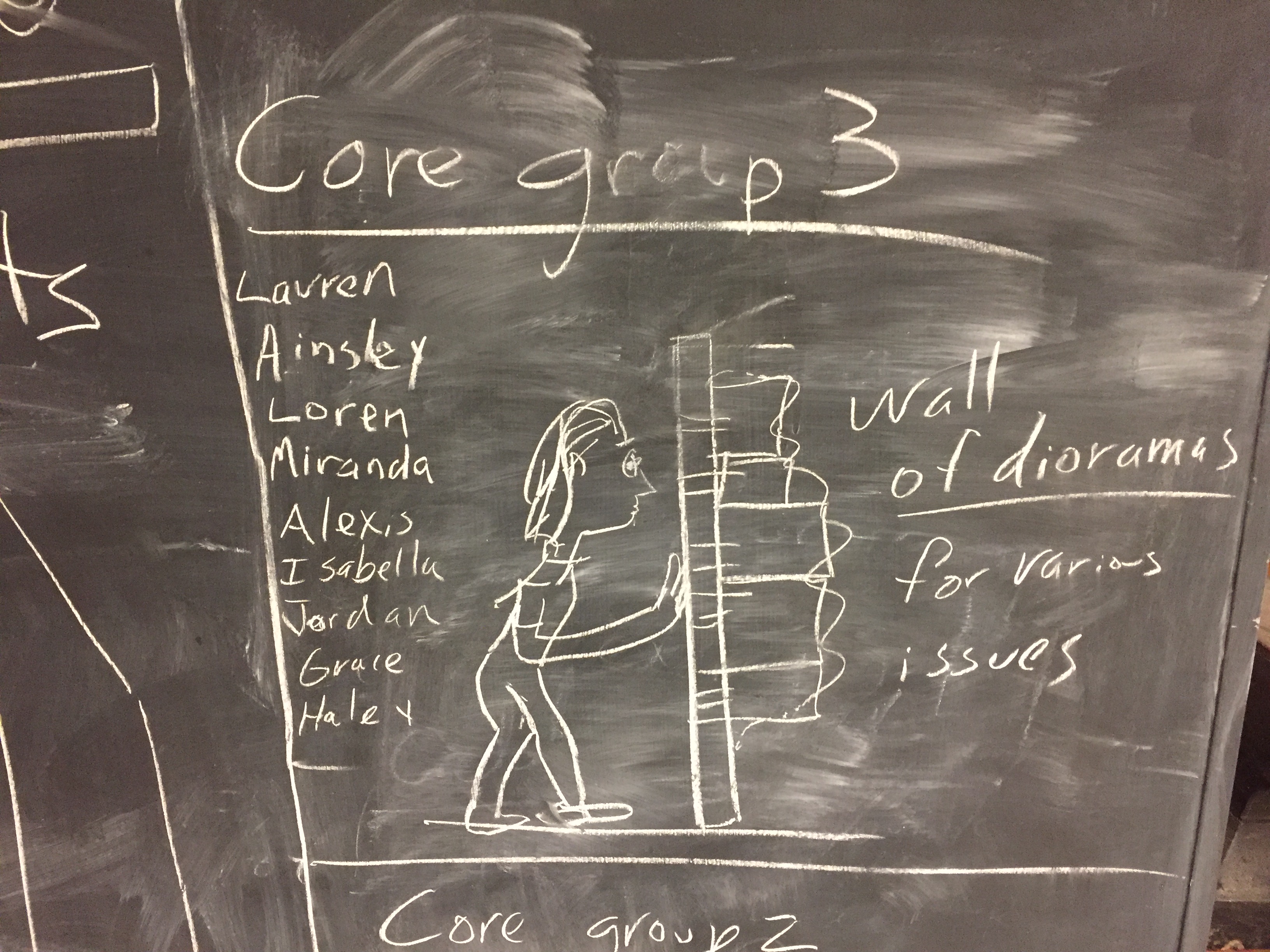
This May I spent thirteen days at Upper St Clair High School as resident artist. I spent two weeks with a core group of around forty students (and two very supportive art teachers) to develop and create a public work for the school. I then spent three days visiting classrooms to provide an arts experience for all tenth graders.
I generally compose residency plans after meeting with school administrators and representatives from the PF/PCA Artists in Schools & Communities program. Although I design lesson plans in advance, my school residency projects are largely student-driven. I facilitate a process that involves learning, experimentation, brainstorming, decision-making, planning and implementation of a project. This is a lot to accomplish in ten days with a core group. Regardless of the final outcome, the rigorous pace gives participants experience in being part of a collaborative project. Compromise, delegation of tasks and teamwork are essential.
The project was broken down into one week of research and exploration followed by one week of construction and placement of an installation. This schedule allowed us to figure out ideas that we wanted to express in the work. It also gave all participants a chance to express their ideas.
WEEK 1: Project Brainstorming & Planning
The core group project began with the goal of developing a student-informed project that would express themes of empathy and understanding. I began by giving the students a presentation of my work, emphasizing the various forms that art can take. These included site-specific installation, public art events, social projects and performance art.
On day two, core groups viewed a presentation of works by contemporary artists addressing social issues. We looked at how Pedro Reyes addresses gun violence through projects that transform guns into musical instruments and gardening shovels. We looked at the work of Chinese artist Ai Weiwei and discussed his messages of freedom, justice and equality. After the presentation and discussion, participants were given a survey asking them to describe issues that they feel strongly about and to suggest ideas for a collaborative project. We wrapped up with each student sharing an idea from their survey.
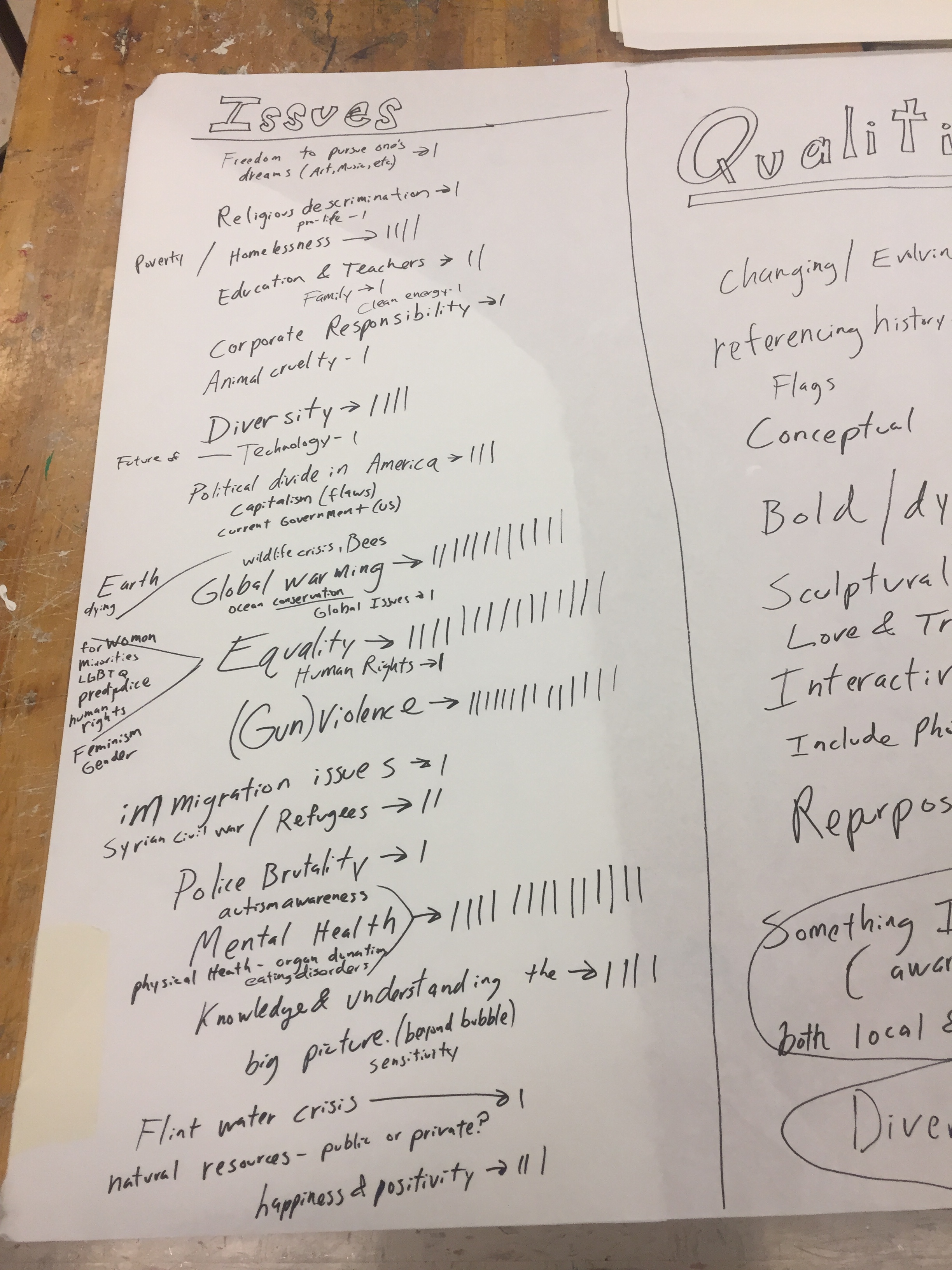
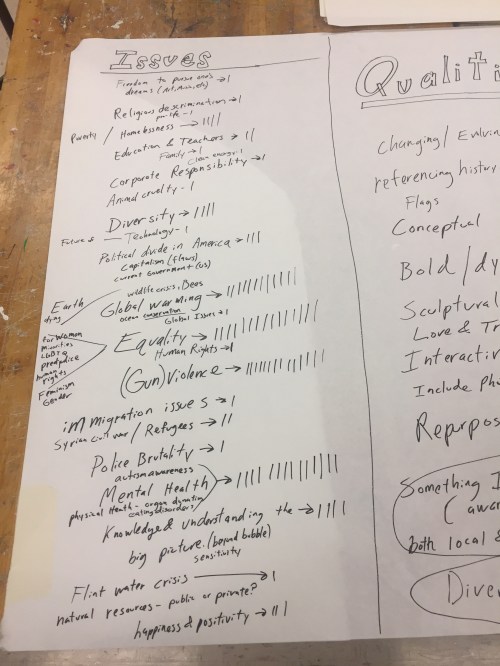
Our initial discussions and survey revealed a wide variety of interests and ideas. On the third meeting we looked a compilation of our collective concerns including equality, mental health and the environment. Our investigations into the motivations for art making made for some interesting philosophical discussion.
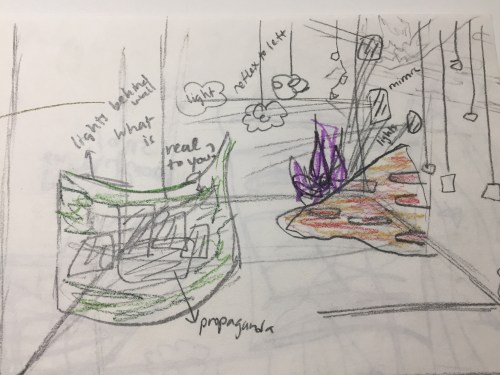
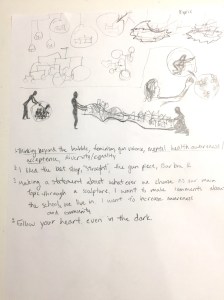
An early student sketch.

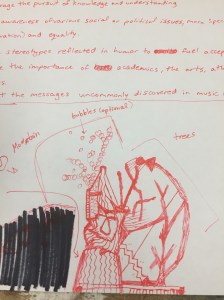
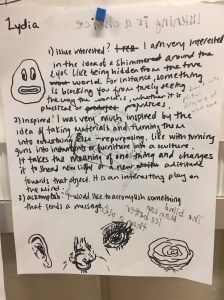
A student survey with sketches.
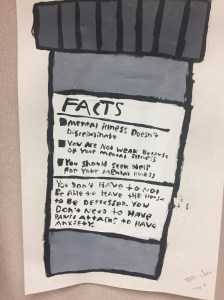
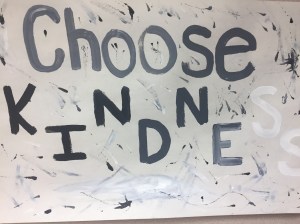
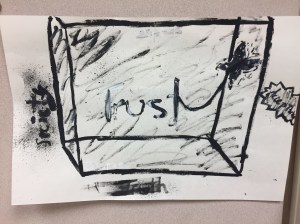
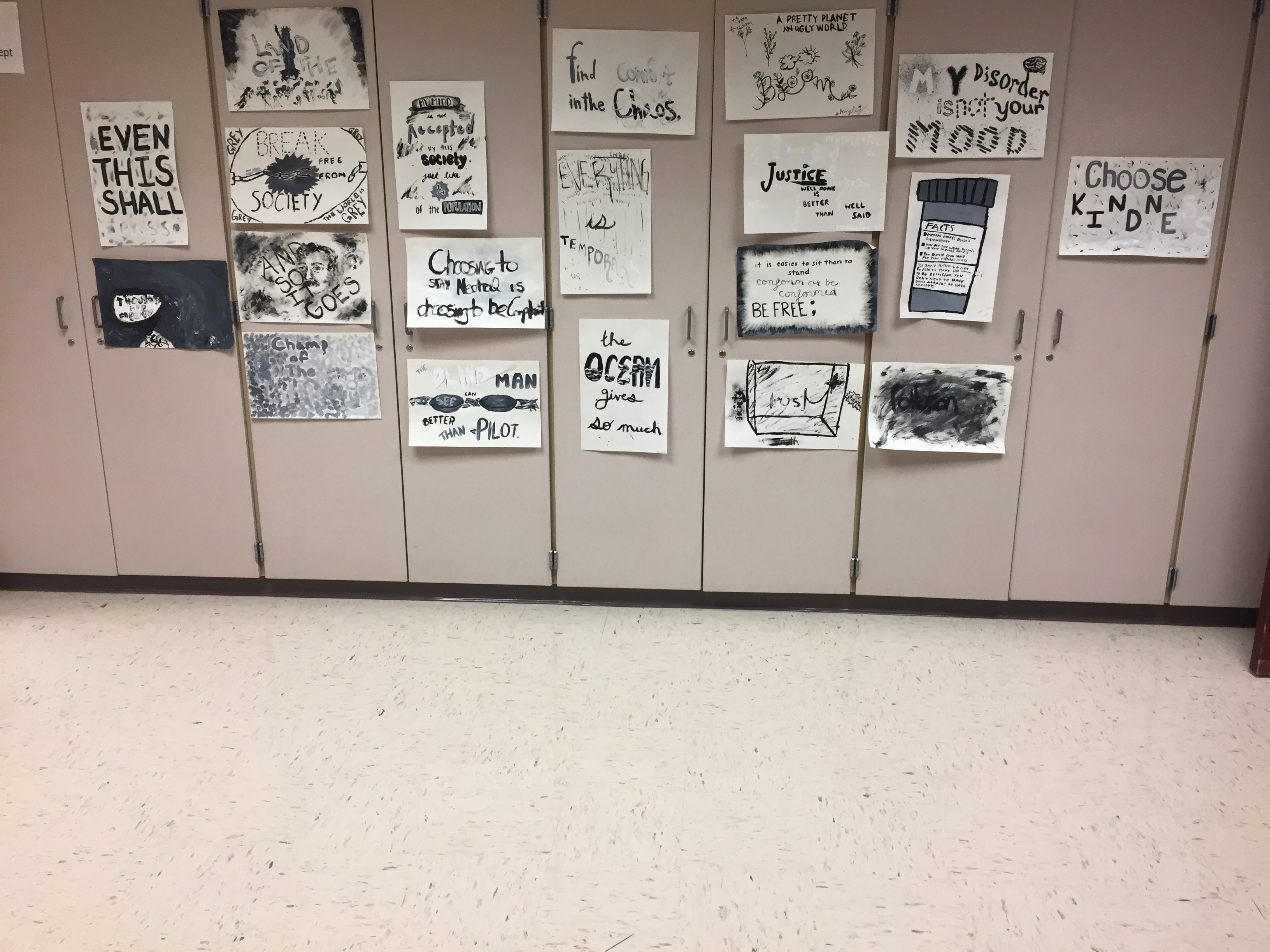
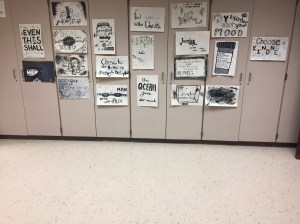
Day three transitioned into an exercise in voicing our ideas through text-based art. After looking at examples by Barbara Kruger, Glen Ligon, Vanessa German and Bruce Nauman, each participant created their own text-based work in black and white acrylic on paper. Some of the challenges of the exercise were 1. Trying to present a clear message. 2. Thinking outside of one’s own knowledge and experience to create a piece that exhibits understanding and empathy. 3. Keeping the works creative. After works were completed, we arranged them in a school hallway and had a critique. Some of the text-based exercises were later attached to our final installation.


To refocus the core group, a collage exercise scheduled for the fourth day was changed to an exercise in manifesto-writing. Through debate and conversation, we realized that the core group was interested in a variety of issues. There was a strong interest in thinking outside of the school district, to have understanding of those living elsewhere. Freedom of speech and expression was also a core value that the group wanted to express. Students spoke of the difficulties in speaking their mind concerning political and social issues. We agreed that celebrating the complexity and uniqueness of each student was important and despite our differences, we could find common ground in work of creative expression.
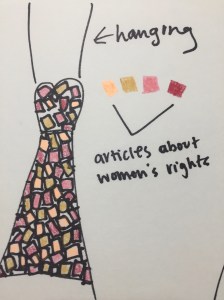
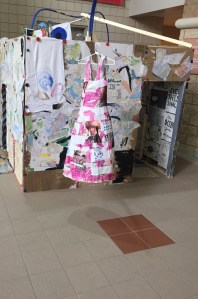
Dress installed in front of final installation.
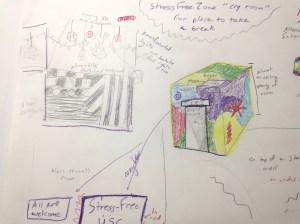
On the fifth day we narrowed down our idea sketches into three ideas including a free-standing sculptural piece, a collection of thematic works and an immersive room containing focused areas of activity. A room or box-like form was voted on. We then began to sketch some variations of the idea and to prepare a list of materials. Wood and hardware was needed for the structure. The students agreed that repurposing materials was important, so I arranged to pick up a carload of materials from Pittsburgh Center for Creative Re-use.
WEEK 2: Construction and Placement
Monday of the second week began with loading in materials and nervously anticipating where the project could be placed. The students wanted the work to be located in a visible public space in the school. The art teachers were very helpful in getting approval to place the work in the school lobby.
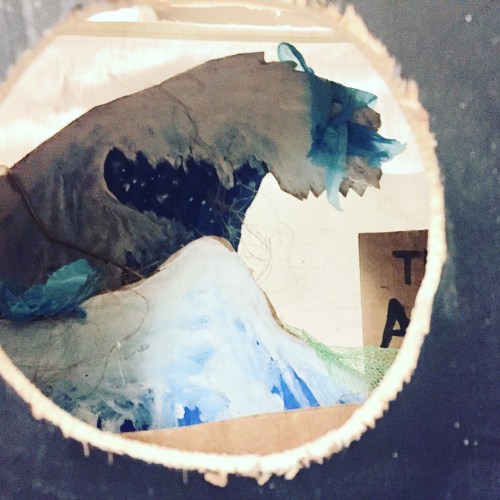
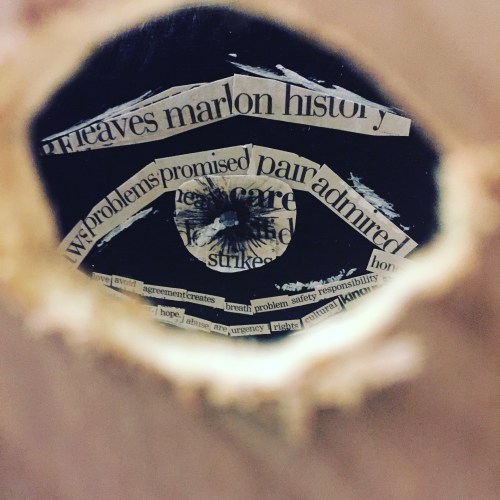
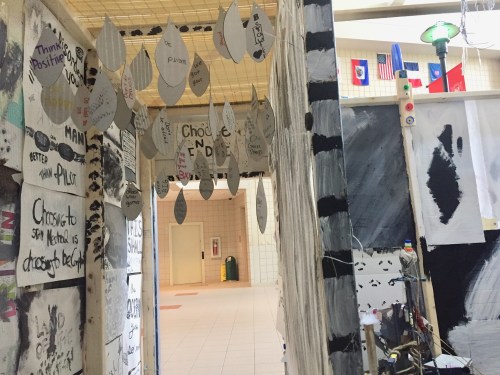
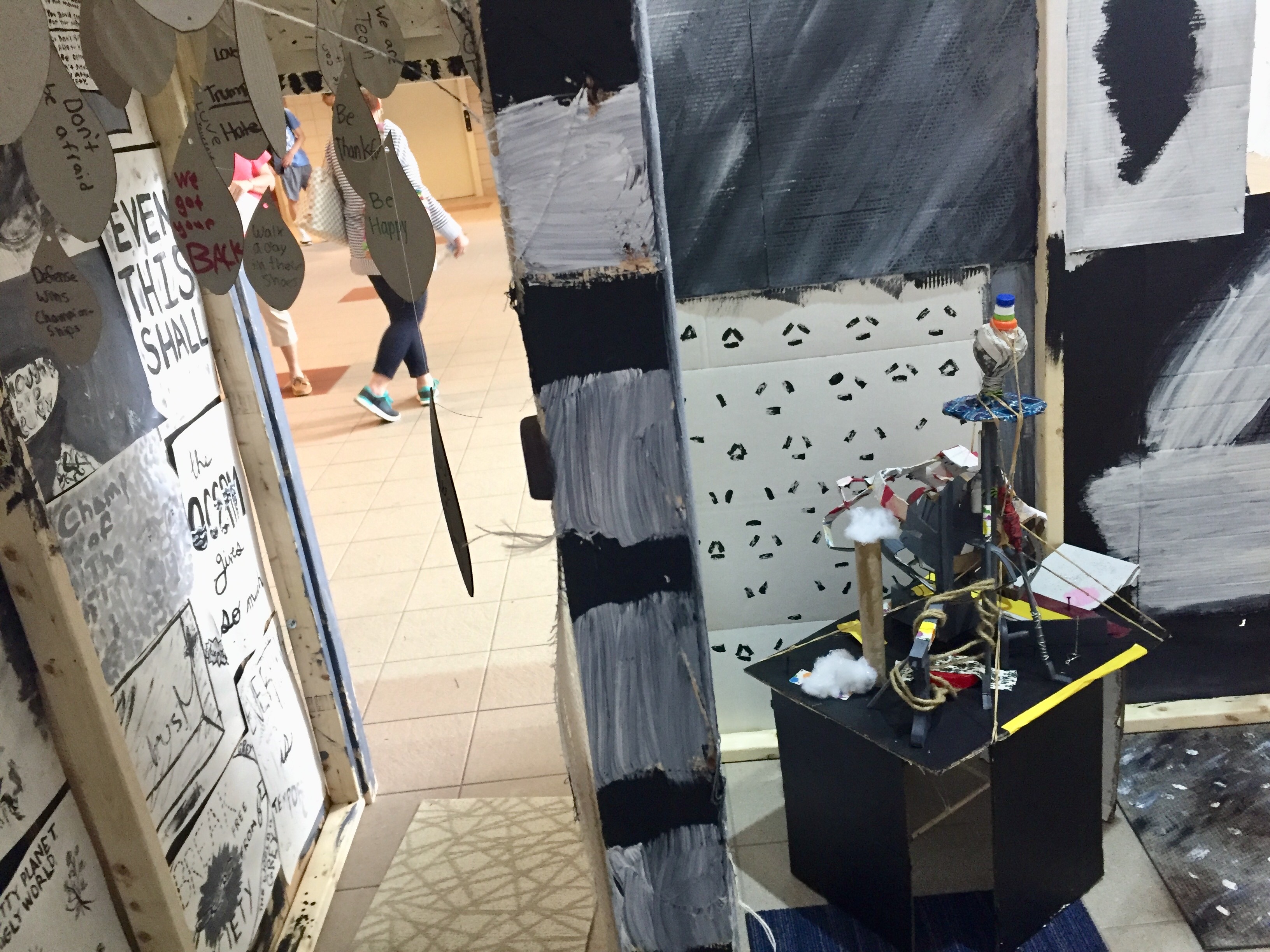
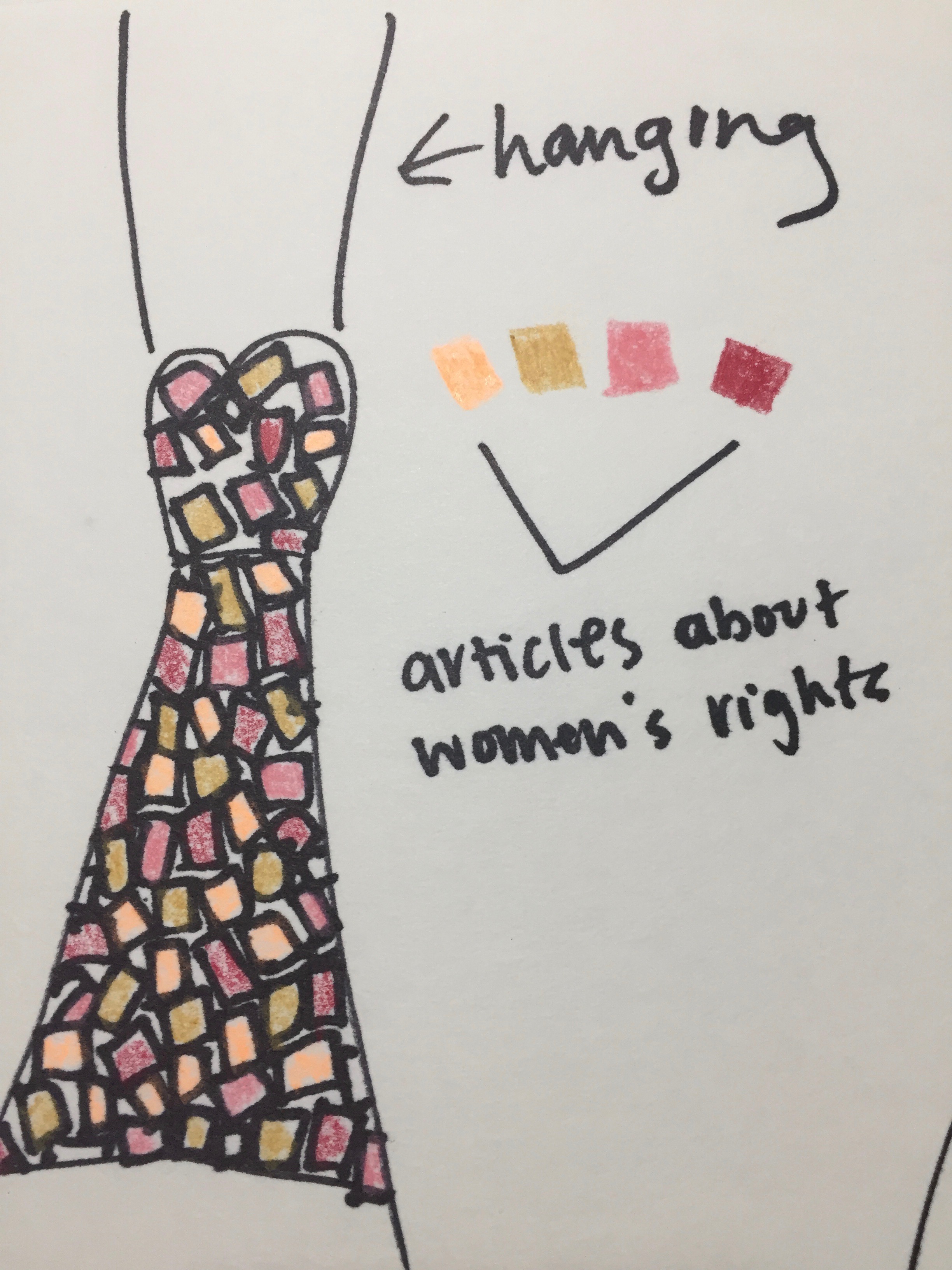
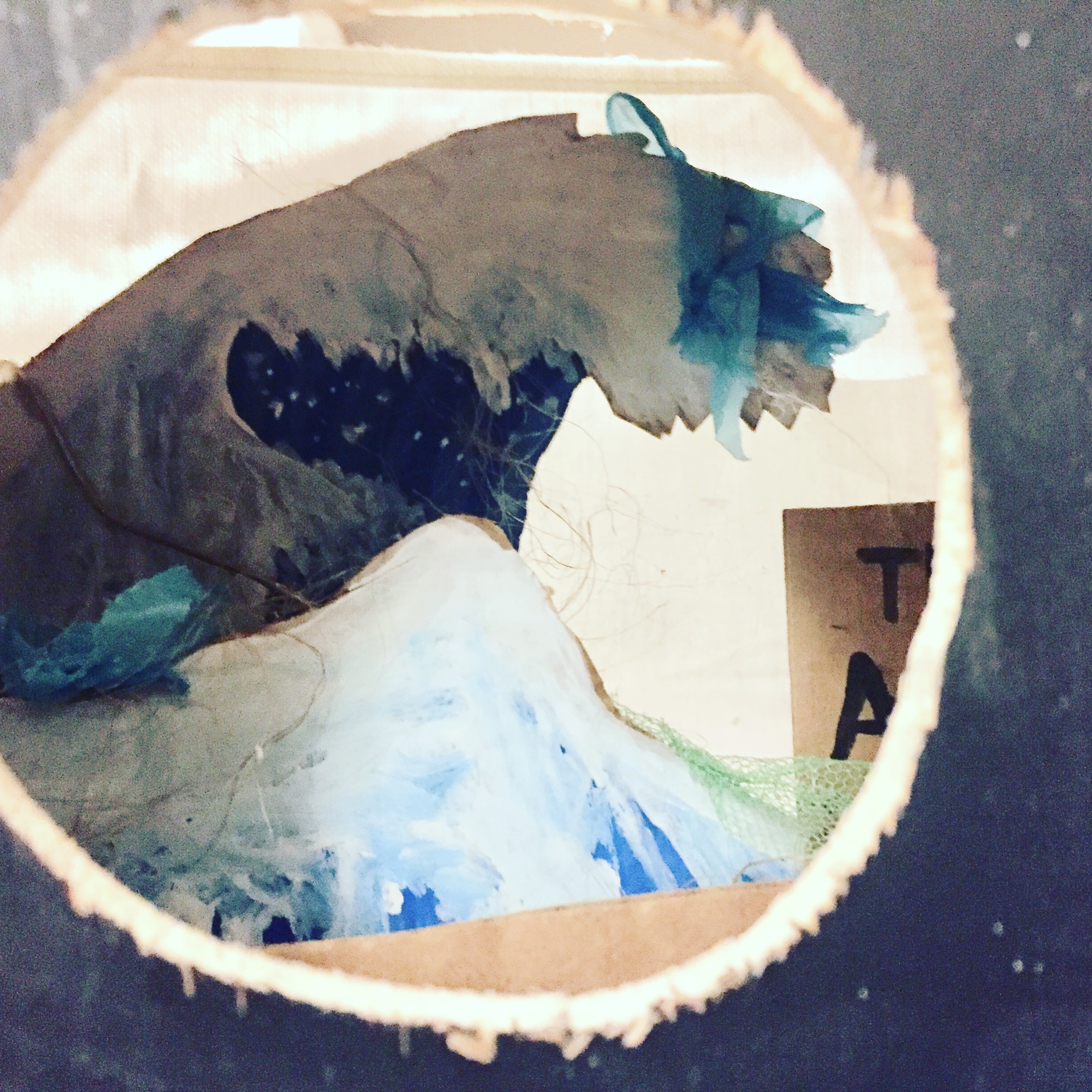
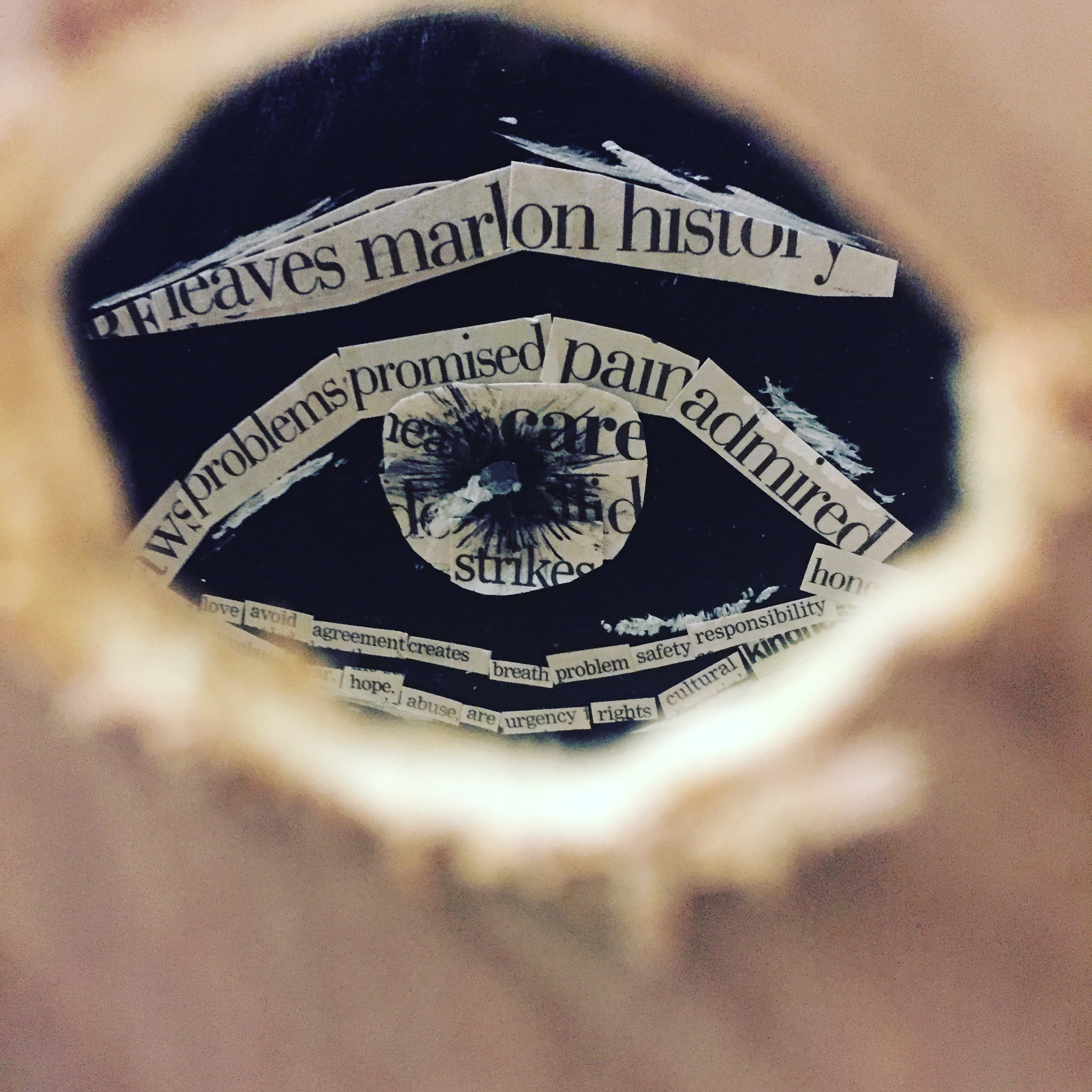
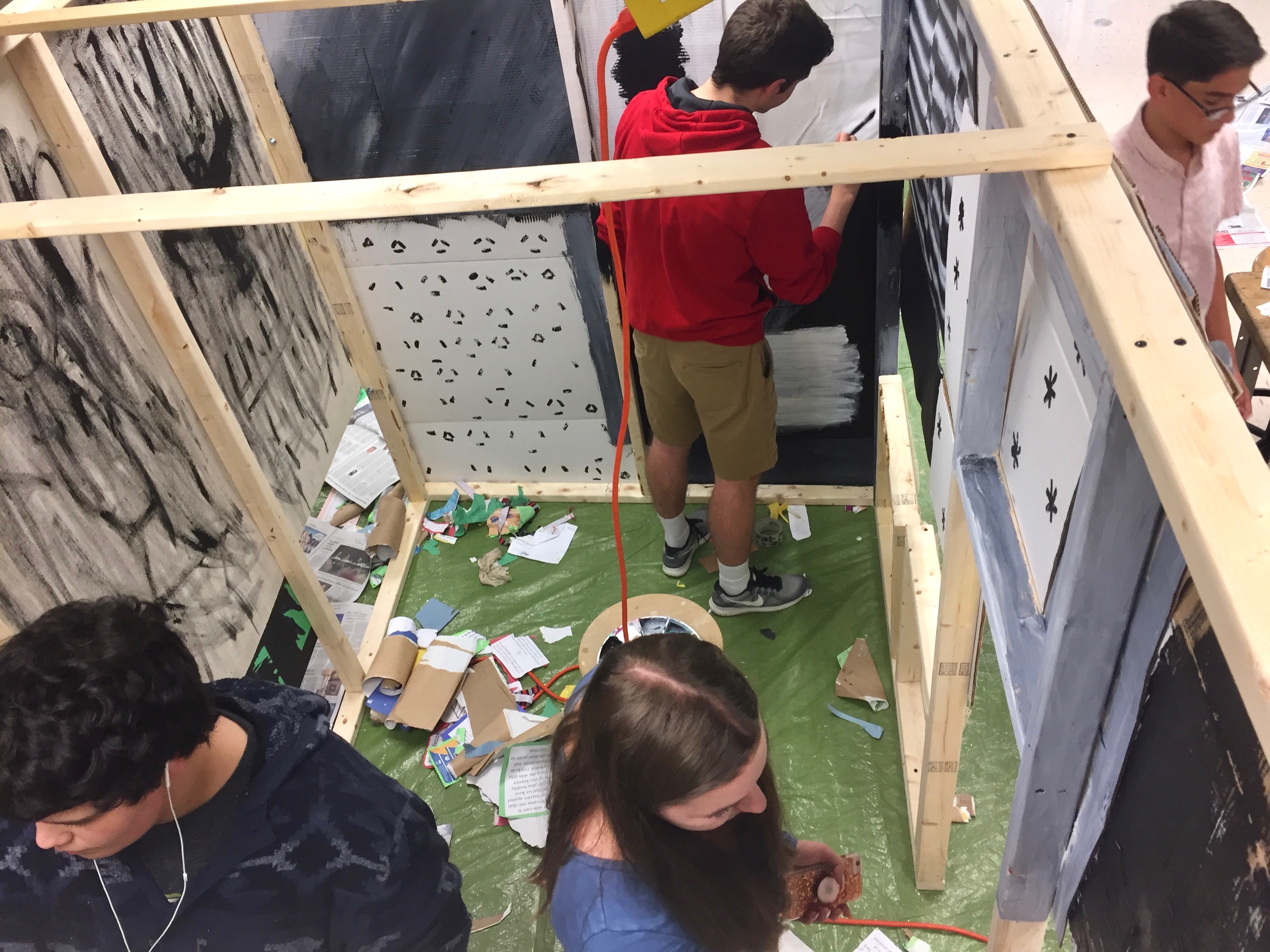
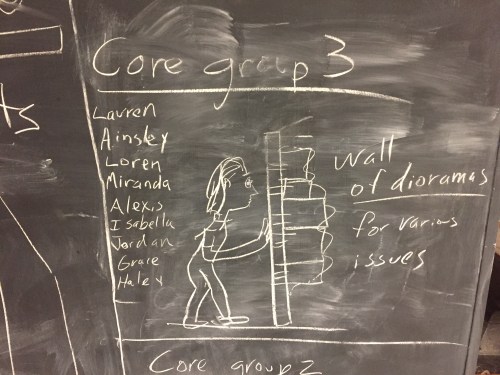
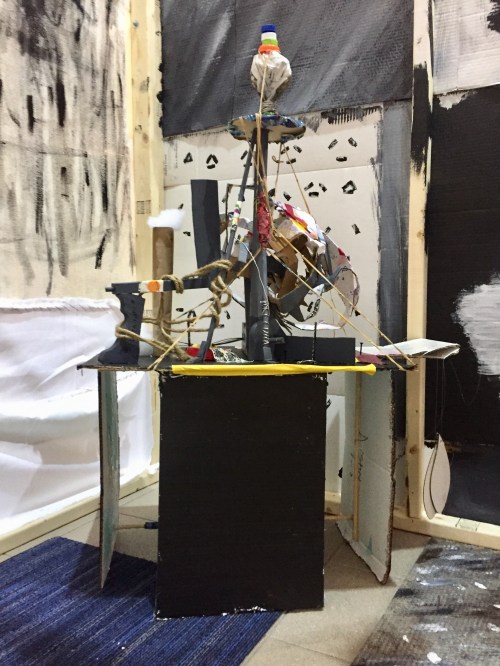
Within the core group, teams worked on various components of the installation. One group worked on an arrangement of cardboard raindrops, laser cut and suspended from the installation ceiling with fishing line. Each drop was embellished with a message. Another group worked on small dioramas, viewable through small holes in one wall of the installation. A third group worked on mobiles and small sculpture to be located within the main room of the installation. One of these works, a life-size dress form sculpture expressing ideas concerning woman’s rights and equality was eventually suspended in front of the installation.
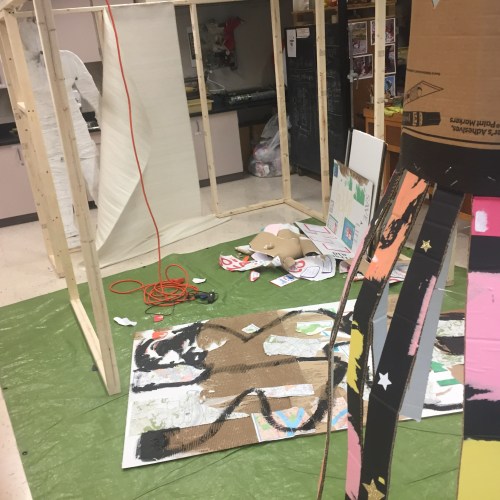
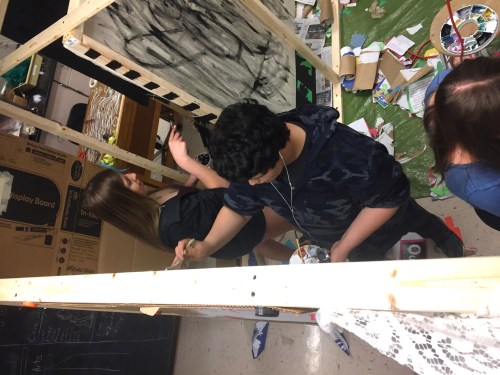
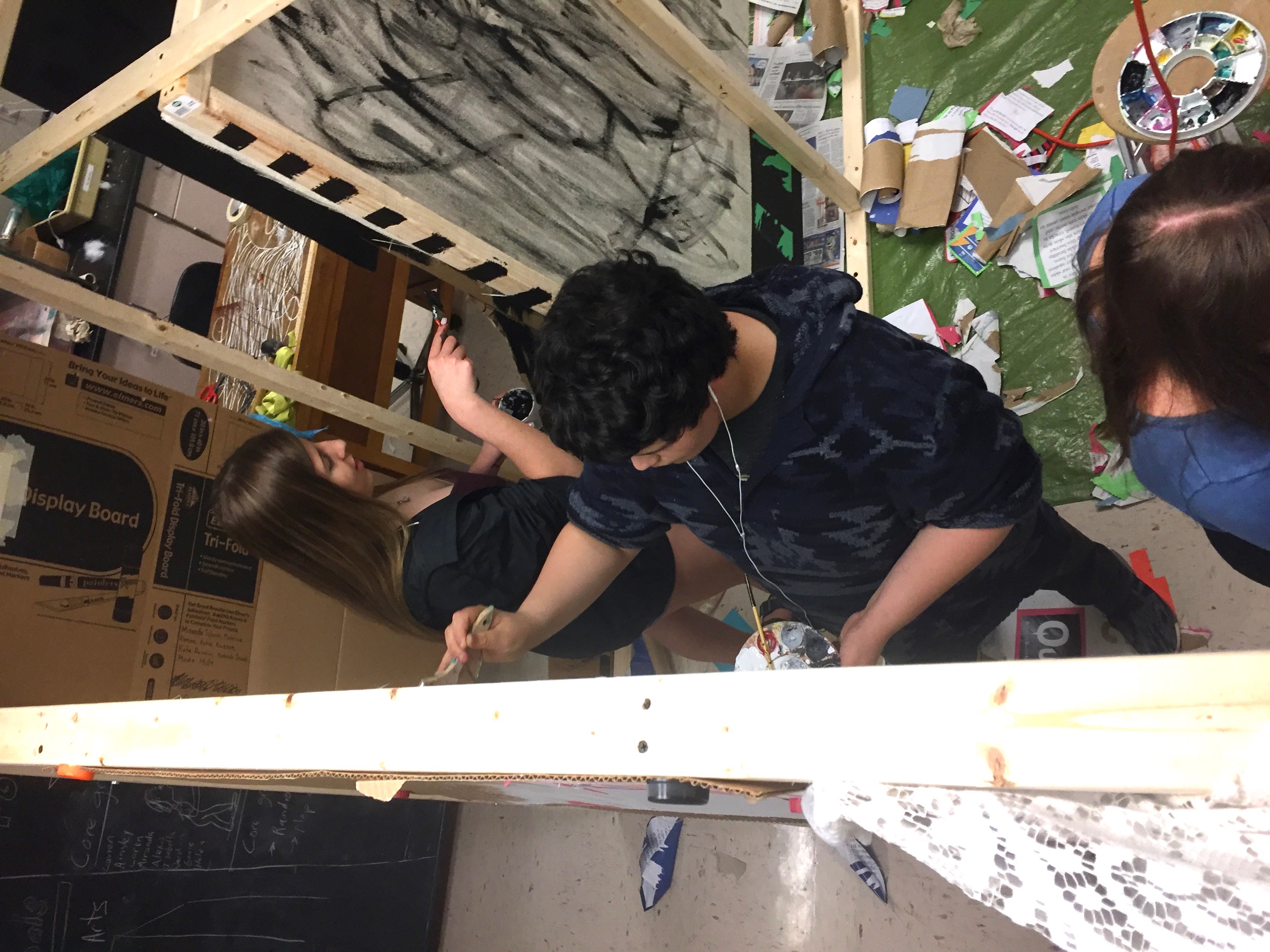
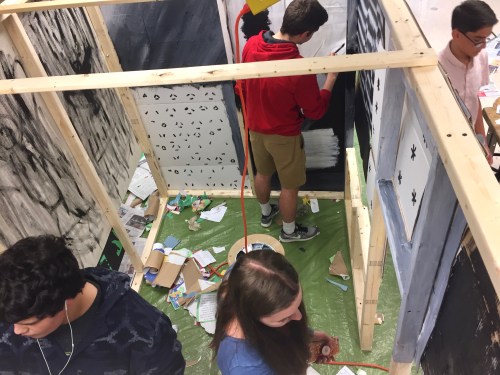
As teams worked, I quickly framed in the box shape with wood and assisted with connecting the various components. Walls were created from repurposed cardboard and fabric. Some students worked on painting interior areas.
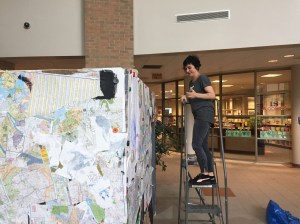
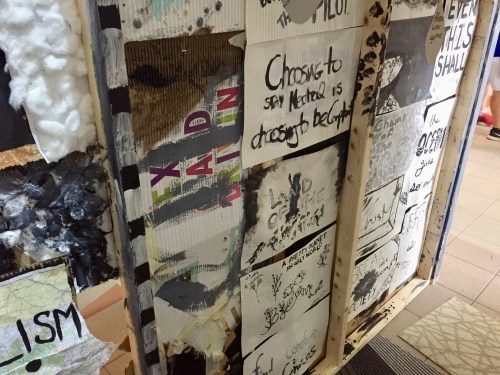
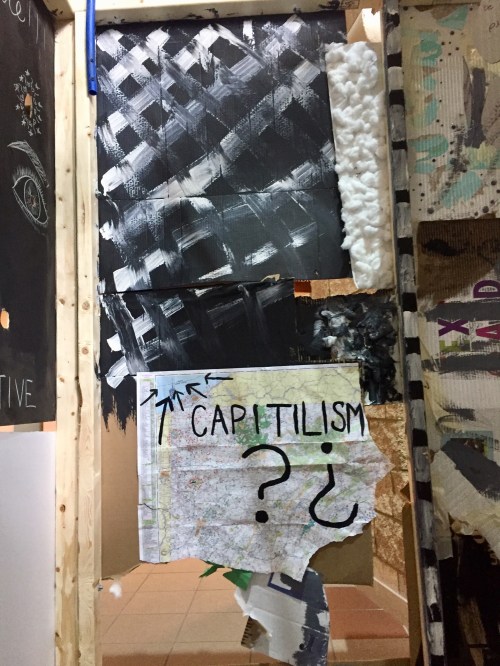
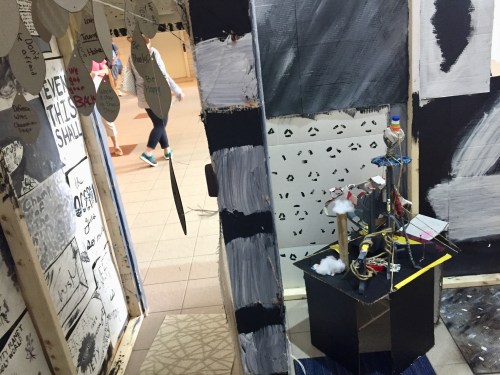
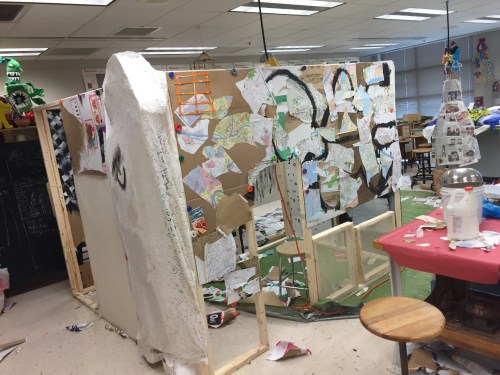
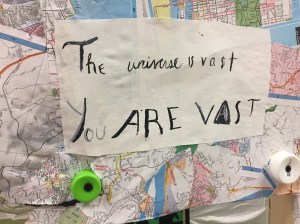
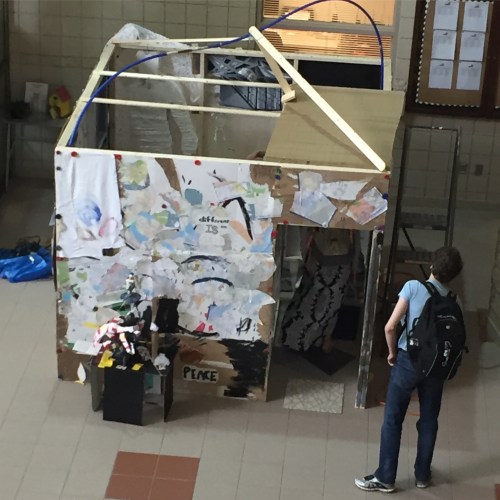
The exterior of the installation was covered with pieces of torn maps, making the final work look like a globe pounded into a cube. At final installation various text-art pieces were attached and collaged onto the work. Two doors and compact space gave the installation a maze-like feel.
Art teacher Robyn Smigel assisting with installation.
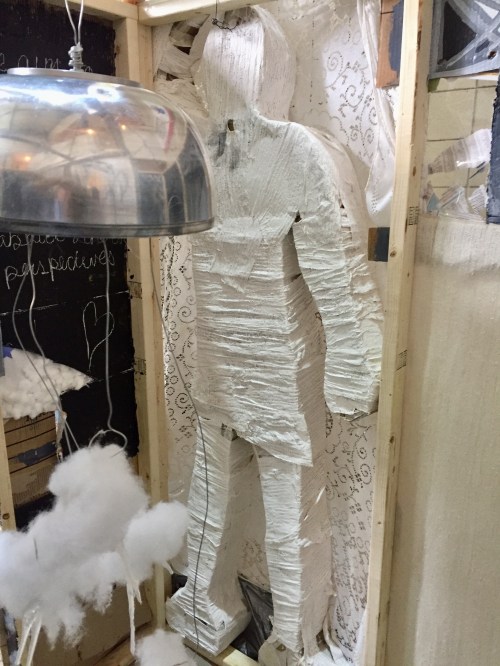

A student painting on the interior.


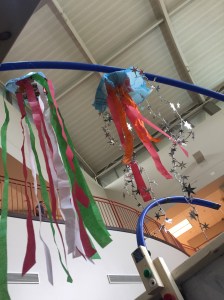
Plastic jellyfish dangled from the ceiling.
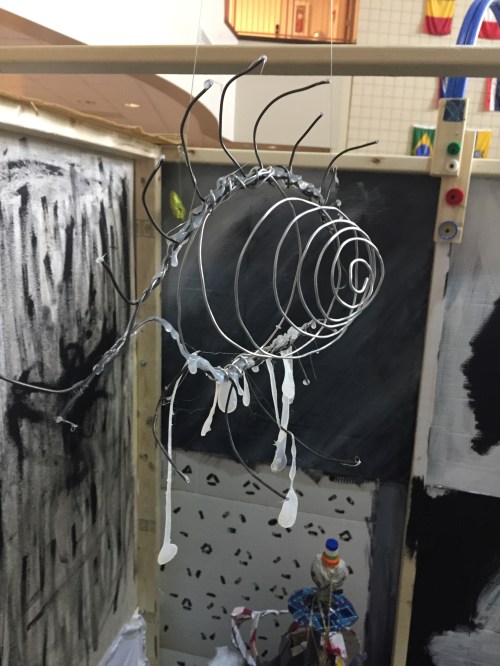
A suspended wire eye.
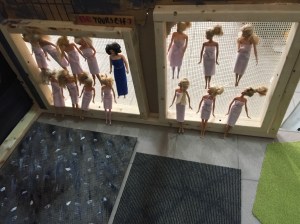
Making a statement with dolls.
The project THE BOX or Finding Common Ground in a Complex Galaxy, opened in the main lobby of the school. A giant hand-made artwork in the midst of a grand institutional entry, the work immediately attracted attention. Some noticed the messages and were excited. Some were confused that their daily surroundings were altered. Some were curious and wanted to explore the inside of the creation. During reflection with students at the completion of the installation, some expressed the difficulties in working on something so abstract over such a short time span. Not everything worked out as planned. Some were unsure of the rough aesthetic. Overall, I think all were involved in a thought-provoking process. All were challenged to think about art in new ways.
Filed under Uncategorized
Several times a year, I visit schools to work with young people on the development and creation of collaborative art projects. Sometimes schools seek me out for a particular project. Most often I’m paired up with schools through Pittsburgh Center for the Art’s Artists in Schools & Communities program. Projects aim for several goals including: 1. Providing students with the opportunity to work under the guidance of a professional artist on a collaborative project. 2. Providing a hands-on art making experience that goes beyond what is generally produced in school. 3. Giving students a stake in a project that involves creativity, trial and error, and decision-making. Aiming for these goals doesn’t always guarantee a successful, aesthetically pleasing or permanent outcome. More importantly my goals stress the importance of creativity, a quality that is often stifled in a highly regimented and heavily structured school atmosphere.
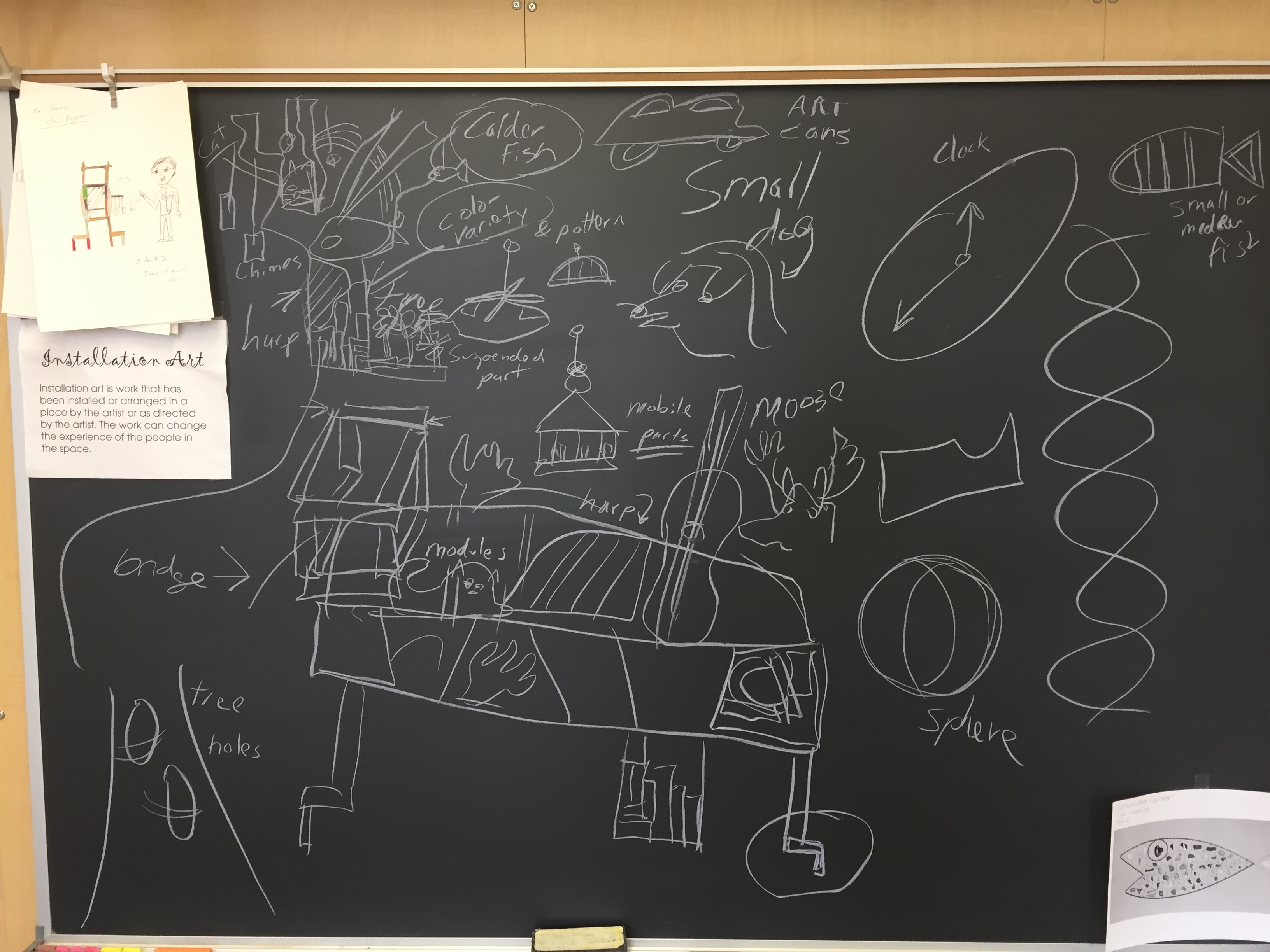
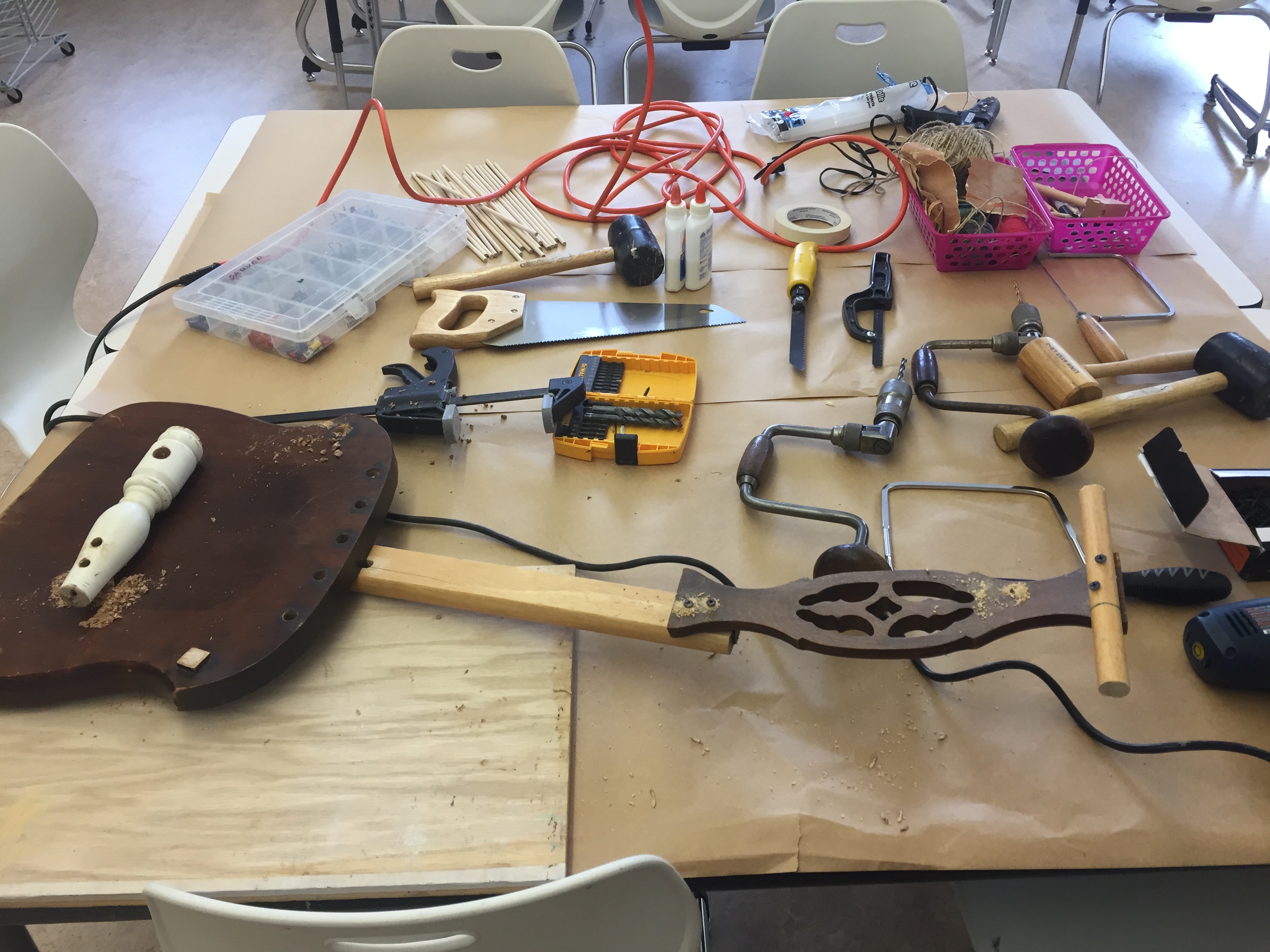
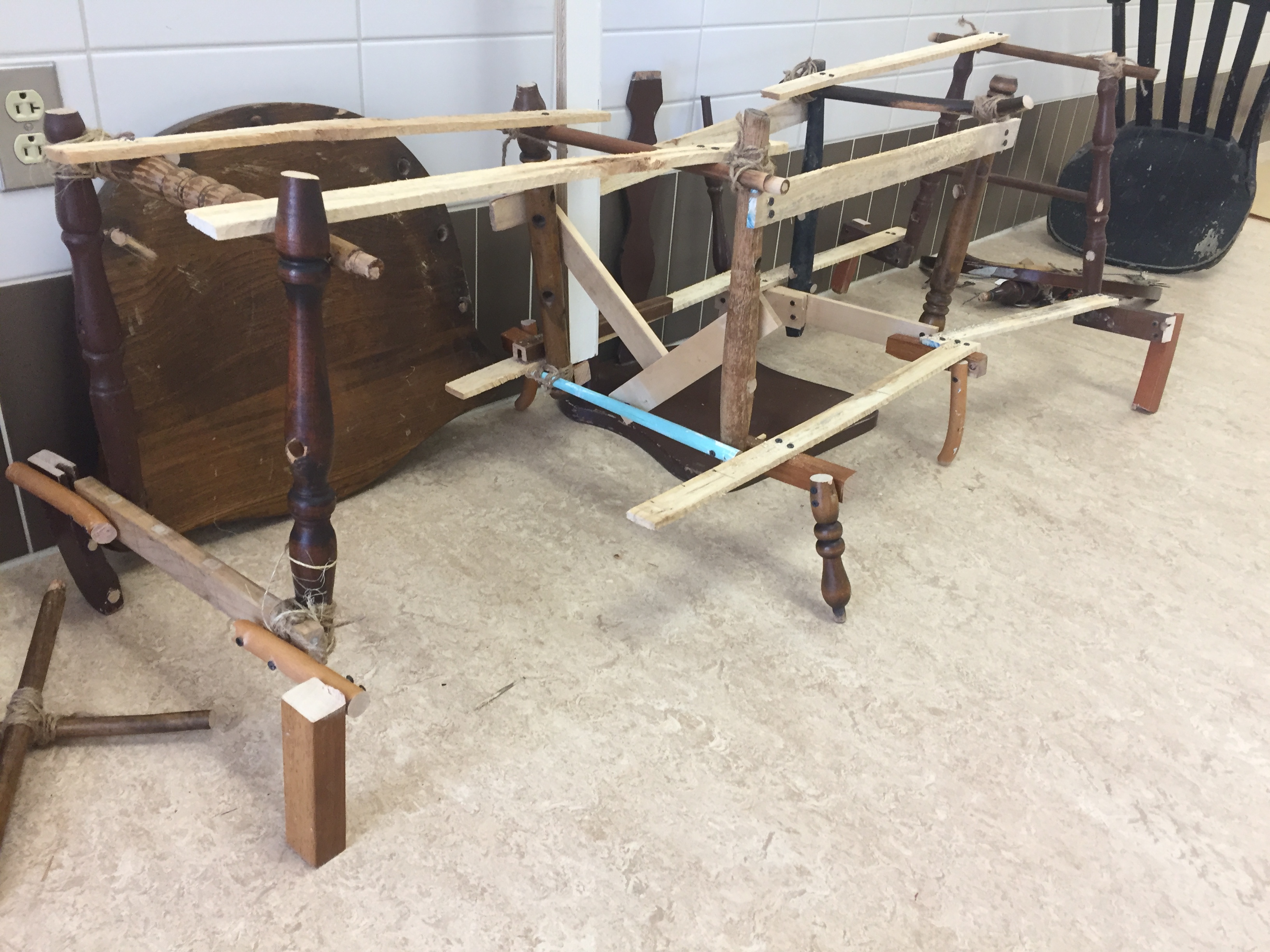
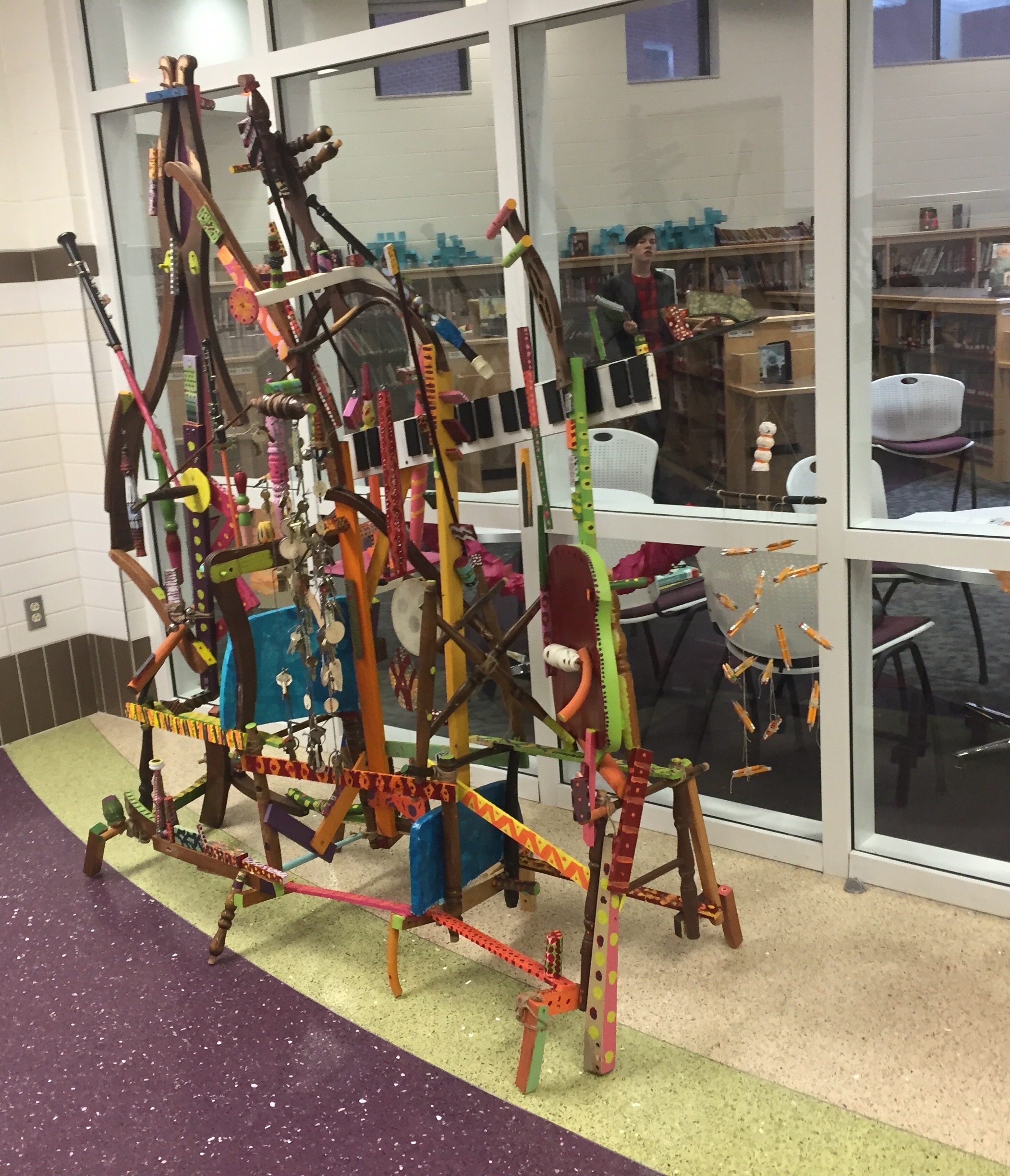
For the musical chairs project, I arranged to bring old chairs, scrap wood and basic manual hand tools to a rural Western PA middle school with the goal of transforming the chairs into a sculpture. On my first day at the school students attended a presentation of my work. I talk about my brainstorming process, inspiration for projects and how to organize a project. We also looked at other sculptors including Jessica Stockholder, Alexander Calder and Pablo Picasso. On my second day, students made individual sketches to brainstorm what could be created out of a bunch of old wooden chairs. The sketches were then compiled on one big brainstorm board.
My third visit involved teaching the students how to safely use a variety of hand tools. These included hand saws, clamps, screw drivers, a brace and rubber mallets. Students were tasked with deconstructing old chairs by sawing them apart or breaking them down with the mallets. For construction, various fastening methods were covered including drilling and pegging, using screws and rope work.
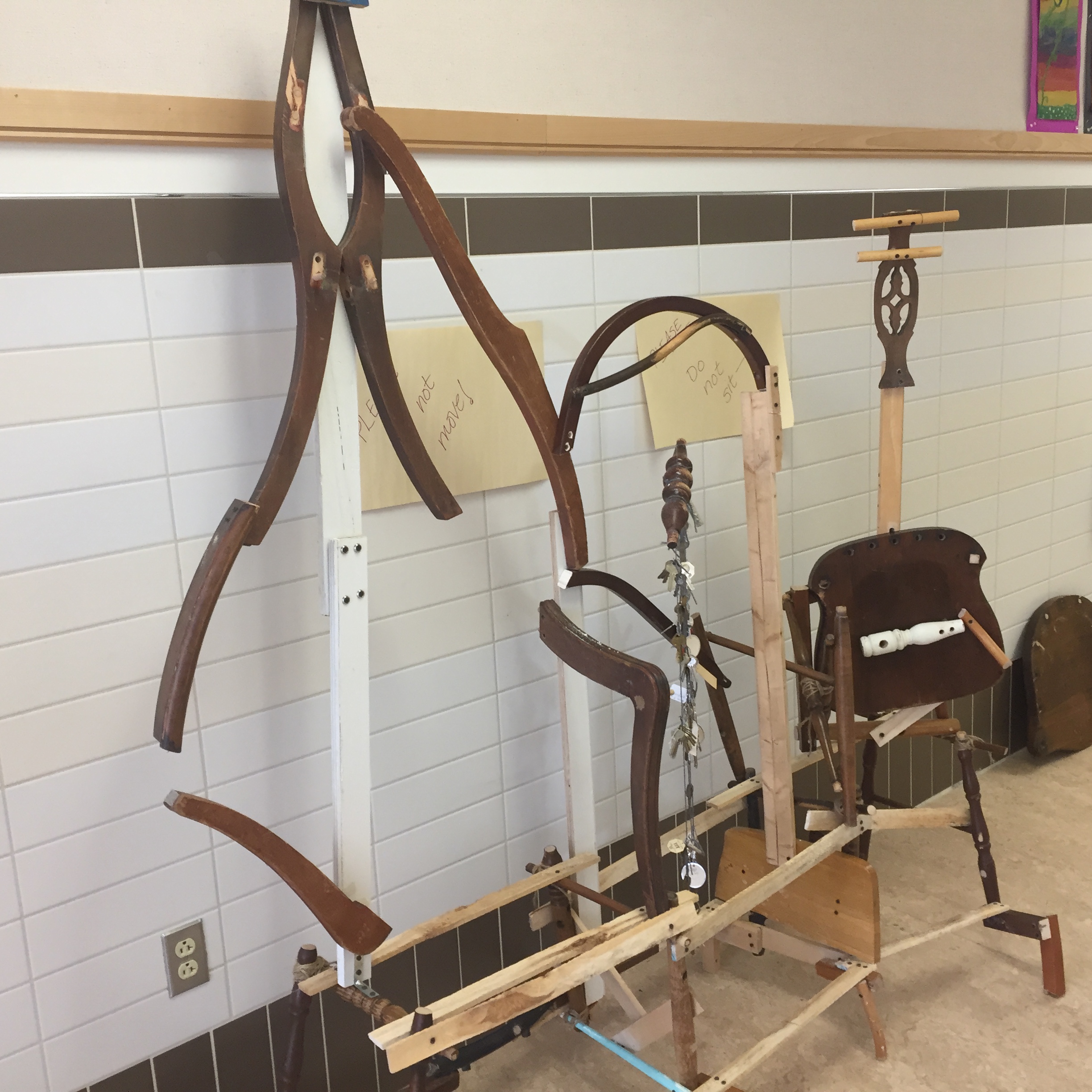
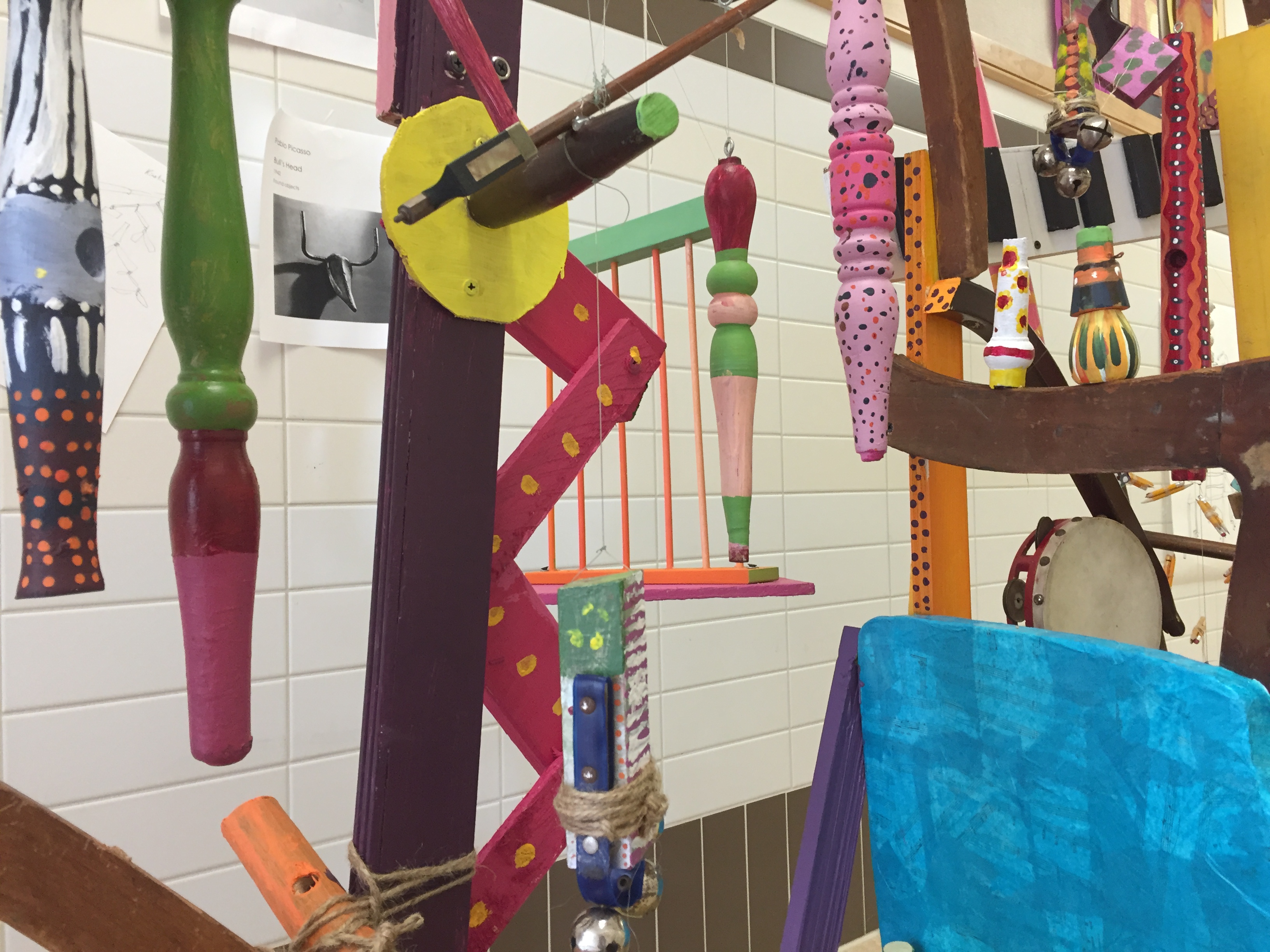
By my the fourth visit, we had an idea of what we wanted to create. We had been experiencing a constant flow of music emanating from the music room across the hall. One of our brainstorming ideas involved constructing a creative ‘park bench’ to place in the school. After thinking about music, we were reminded of Picasso’s Three Musicians, leading us to the ‘musical chairs’ theme. Over the remaining classes, students separated into groups. Some groups measured and cut pieces. Others worked on the main structure of the sculpture. Some experimented in creating interesting shapes and some worked on embellishing parts of the sculpture with acrylic paint. The music department even donated some old musical instruments to be deconstructed and reworked into our sculpture.
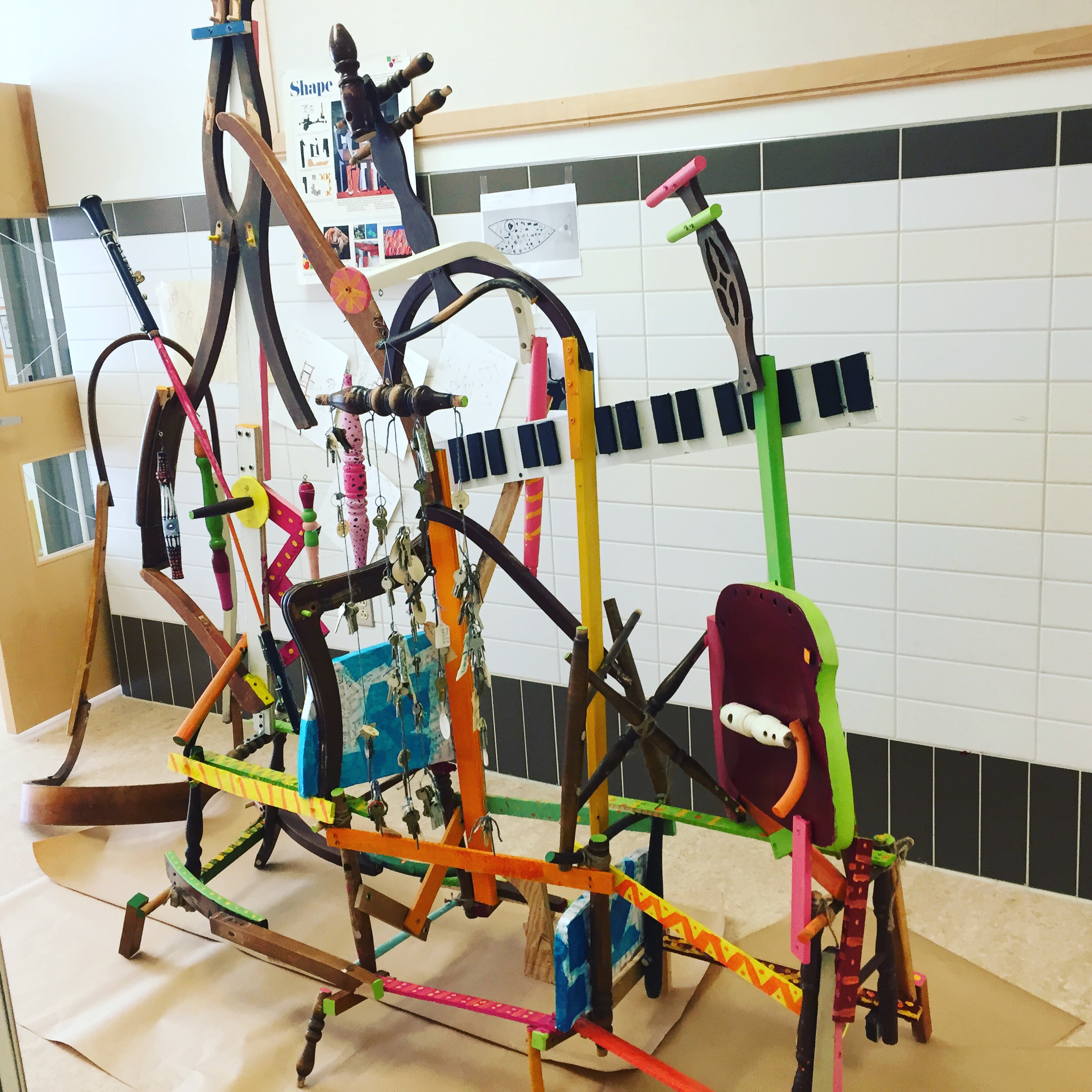
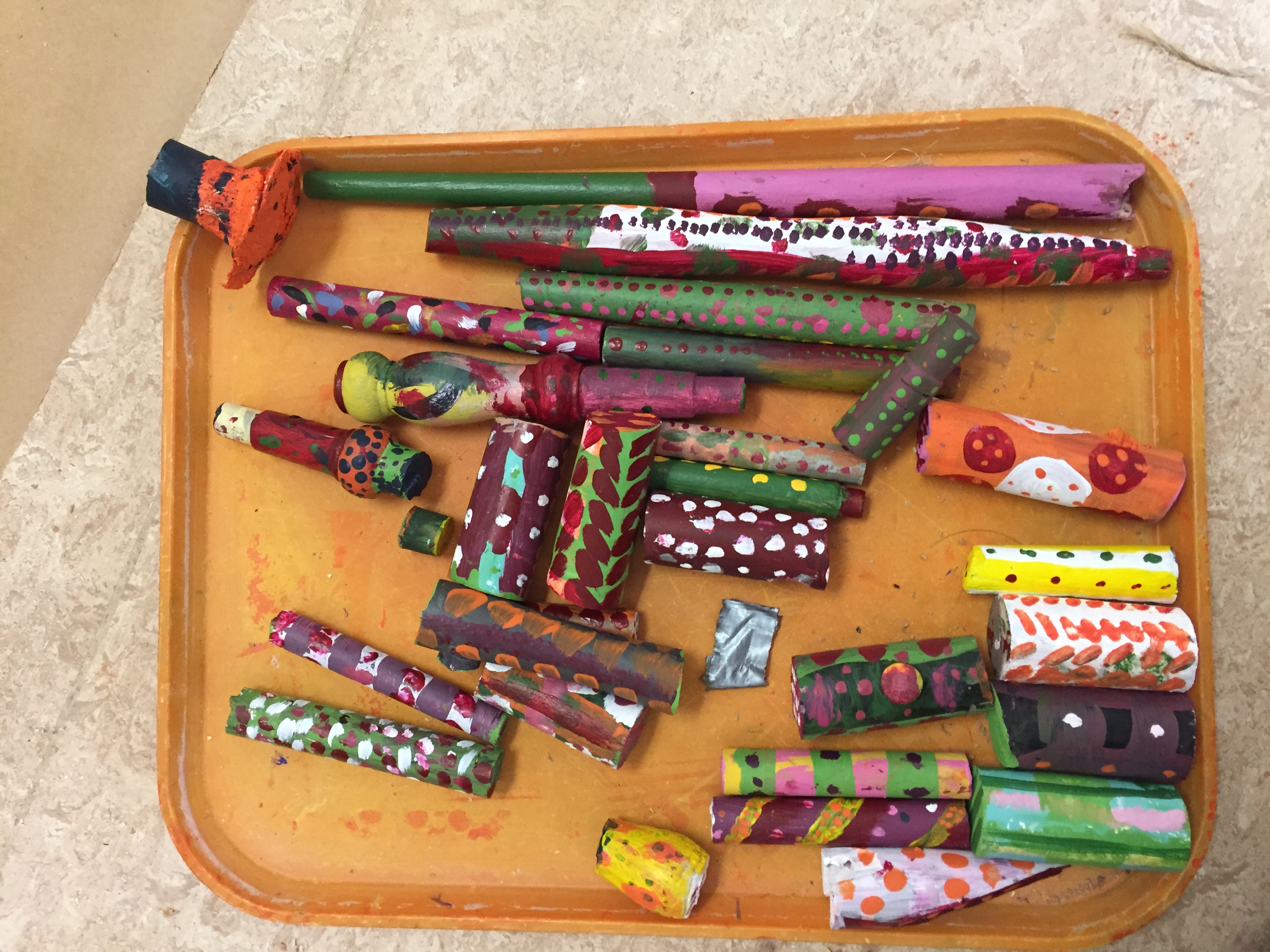
The final piece suggests an ensemble of musicians playing with forms resembling upright bass, electric guitar and keyboard. Colorful wooden chimes give the work a kinetic component. The work was installed in the entrance area of the school library. School rules prohibited photography of students working on the project.
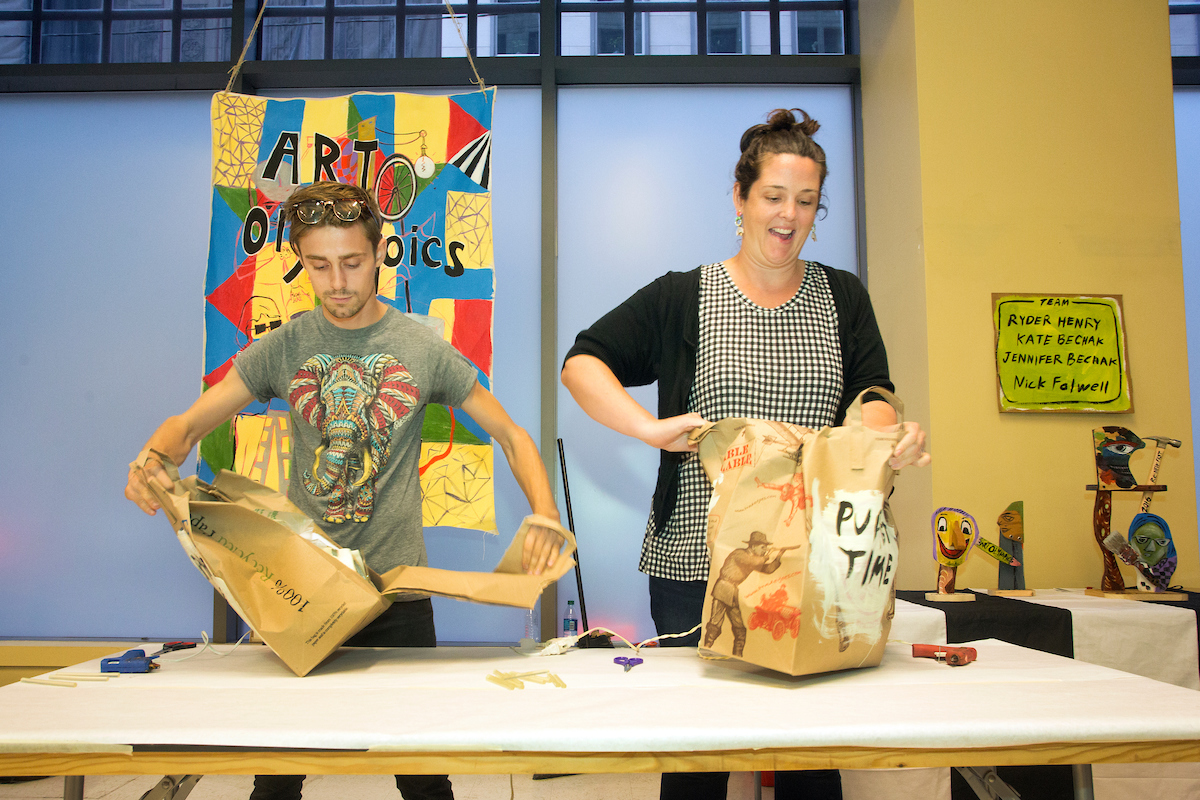
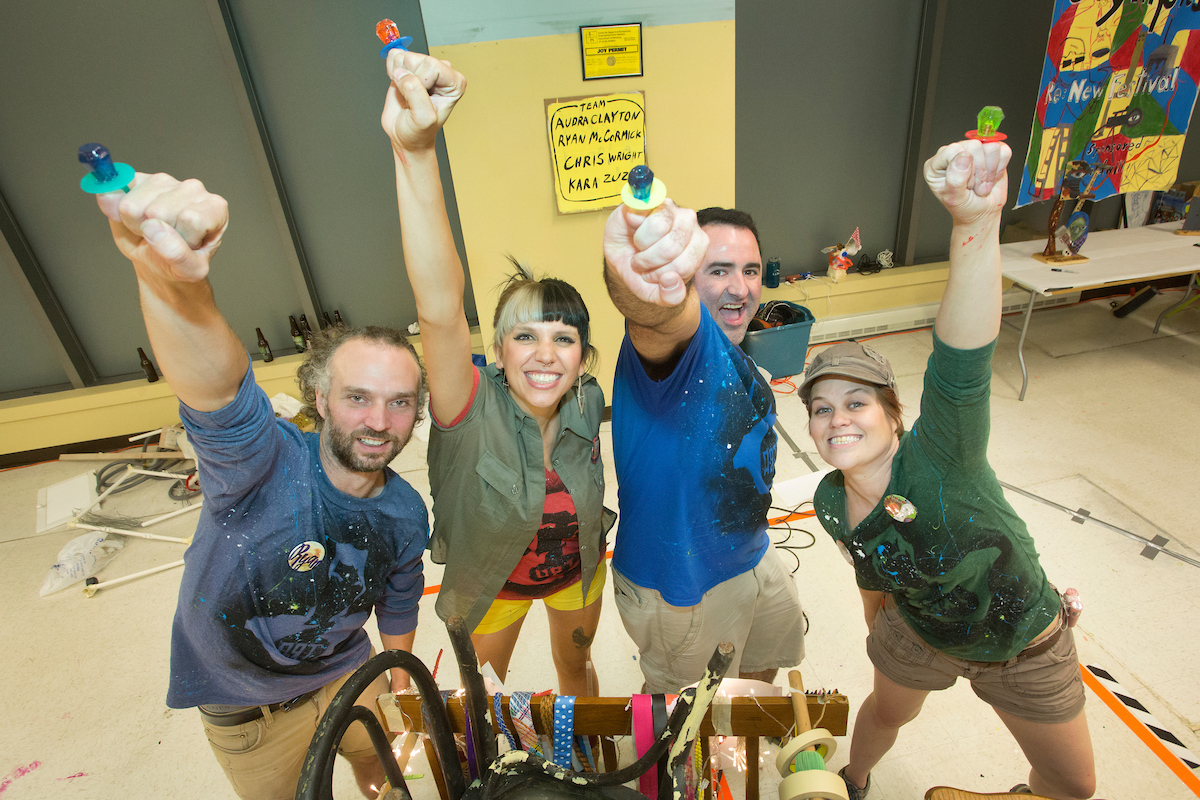
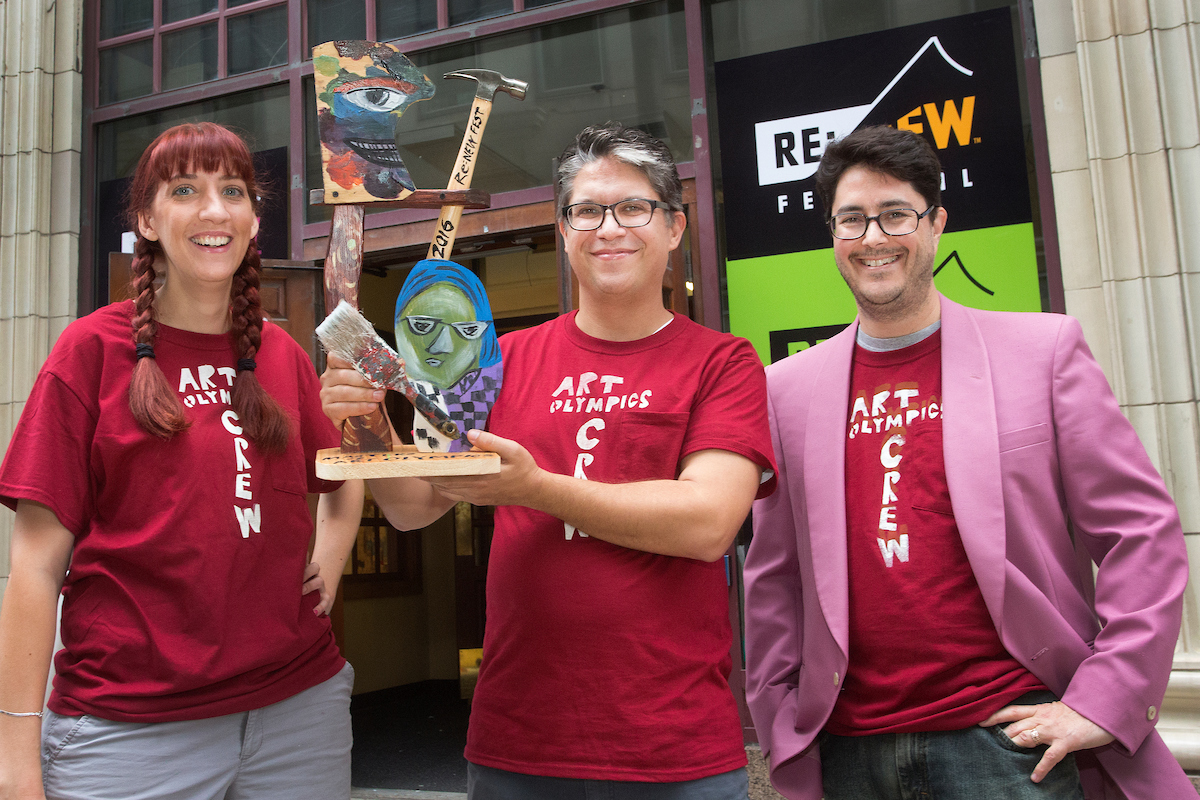
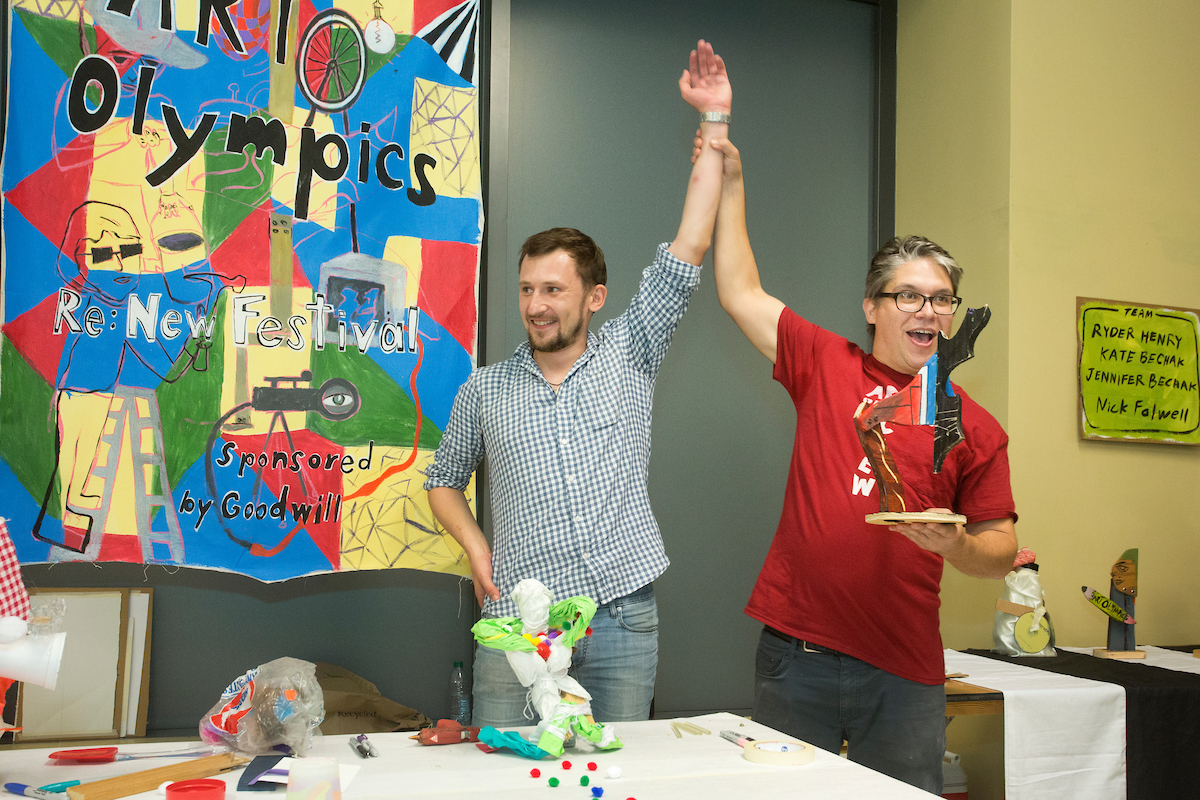
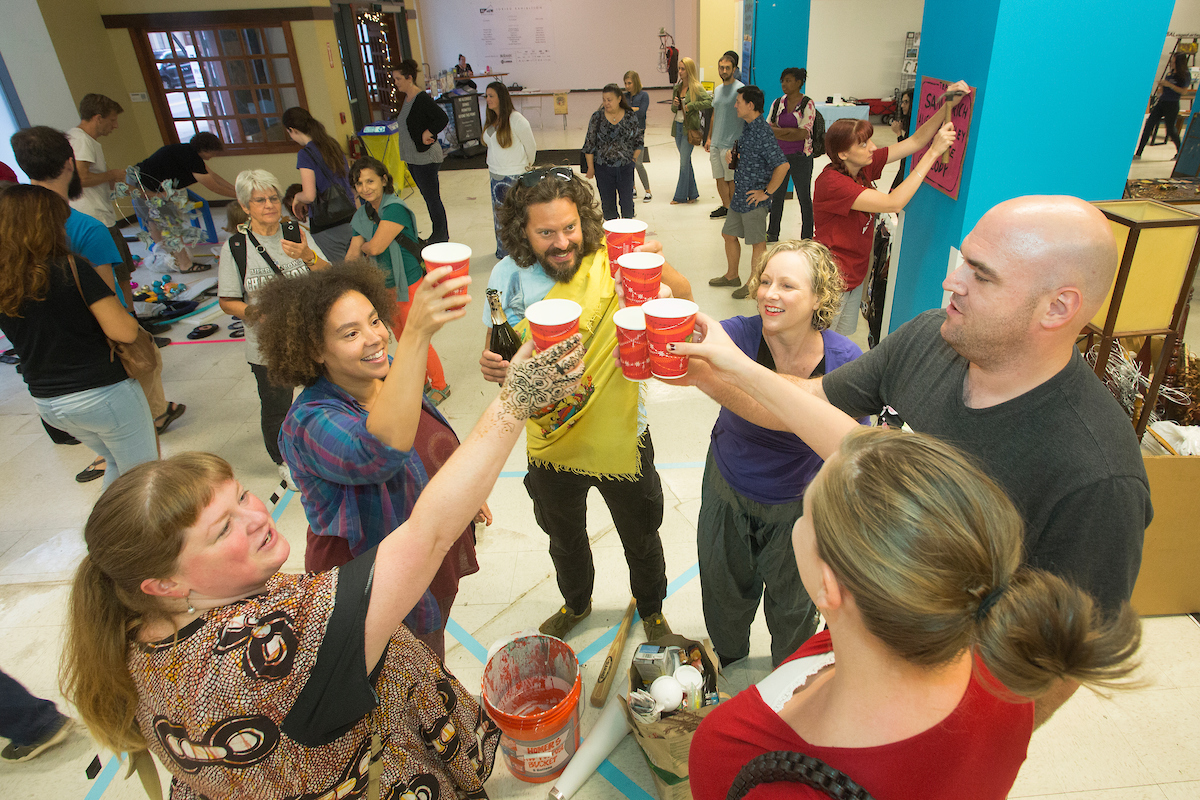
Pittsburgh artist Ryder Henry led team Answers to victory in the tenth Art Olympic competition on Saturday at the Re:NEW Festival, Downtown Pittsburgh. Henry’s team members included Nick Falwell, Kate Bechak and Jennifer Bechak. Henry and team were permitted to bring one brown paper bag of tools into the contest, a bag that appeared to contain a bunch of rusty hand tools. Wasting no time, Answers began by dumping their giant palette of Goodwill merchandise onto their nine foot by nine foot working area. Adversity struck early as a greasy mess oozed from an unidentifiable object being cut with a Sawzall. As their space transformed into an oil slick, event organizers raced to contain the spill. Frantic team members broke down furniture by smashing chairs to the ground. Eventually Answers caught their stride. Objects provided by Goodwill, the event sponsor, were used in clever ways. A rotary telephone was created, complete with dialing mechanism and ringer. At the end, Henry dialed the phone and ordered pizza, singing a jingle recalled from the distant past, “twenty-nine minutes or it’s free!”
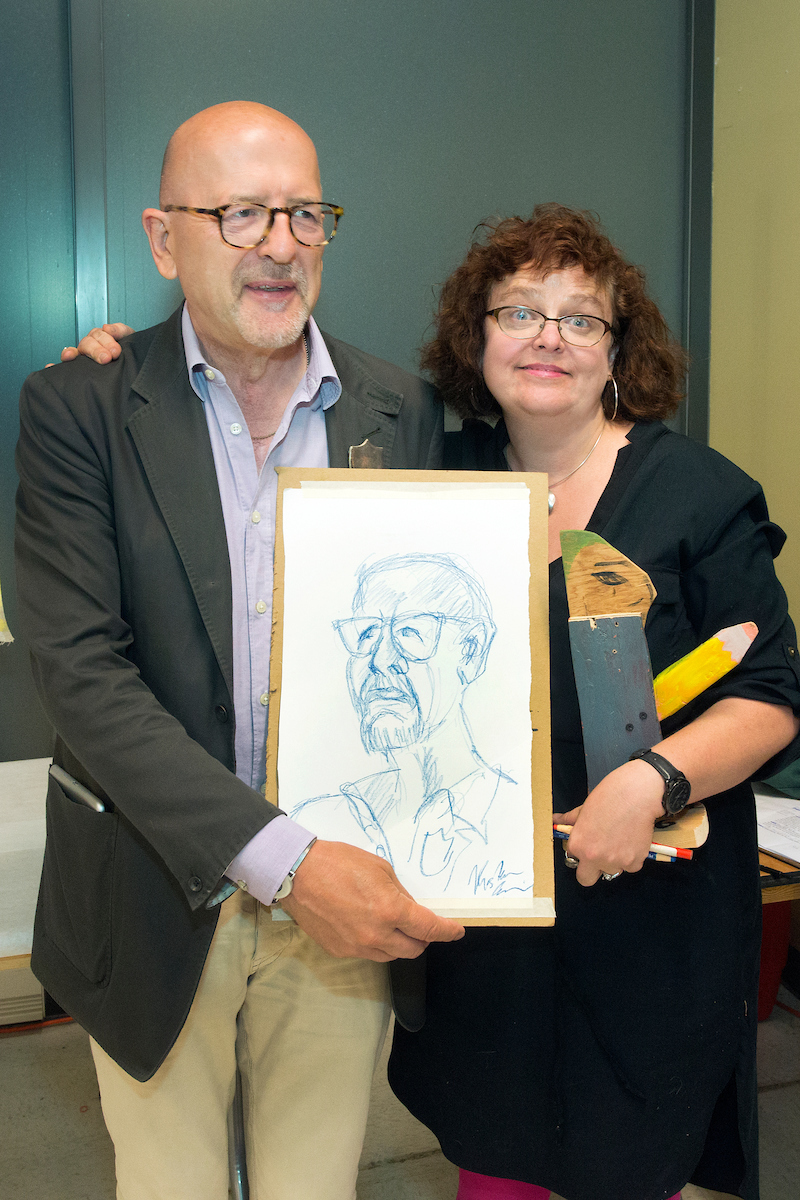
Several audience member’s were victorious in the audience participation games. Ryder Henry’s wife Maya took a break from cheering and won the puppet making competition. A recent arrival from Russia, Sasha, won the Halftime Sculpture Contest. Kirsten Ervin won the Seventh Inning Sketch, capturing a confident likeness of art critic Graham Shearing.
Images by Larry Rippel Photography.

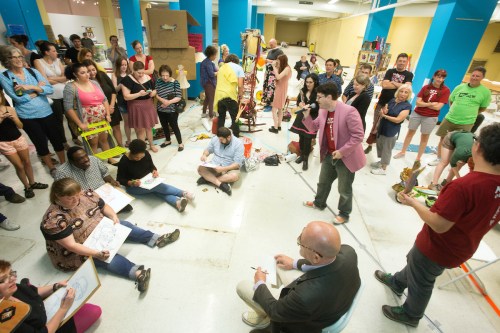
Five audience member took part in the Seventh Inning Sketch, a portrait sketching contest with art critic and event judge Graham Shearing serving as model.

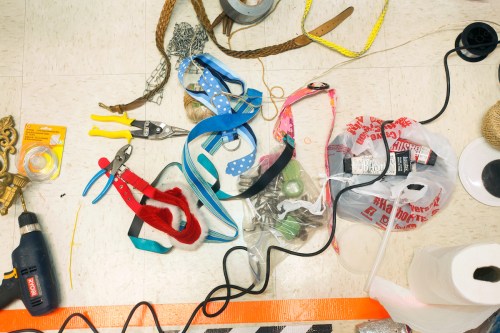
Each Art Olympic Team was provided with a basic tool kit and a giant bin of Goodwill items. Teams were allowed to bring in one brown paper grocery bag of their own objects.

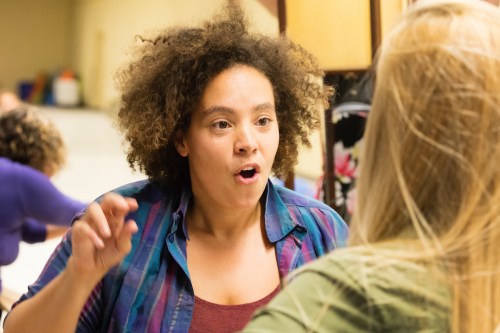
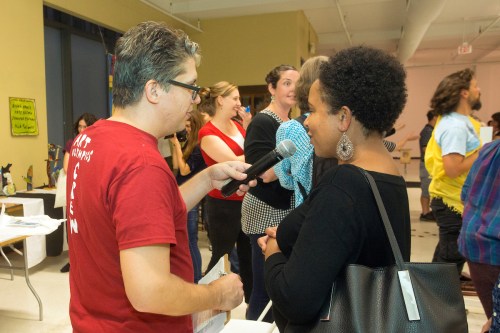
Alisha Wormsley of “Team Trebuchet” interacting with a member of the audience.

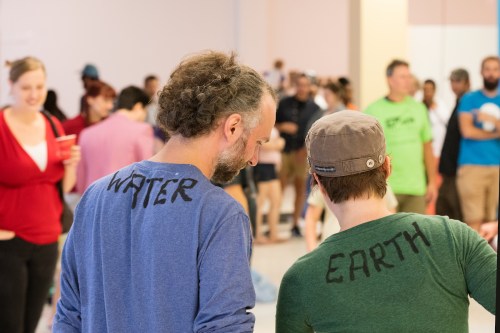
Ryan (Water) and Audra (Earth) of team “Our Powers Combined” discuss strategy.

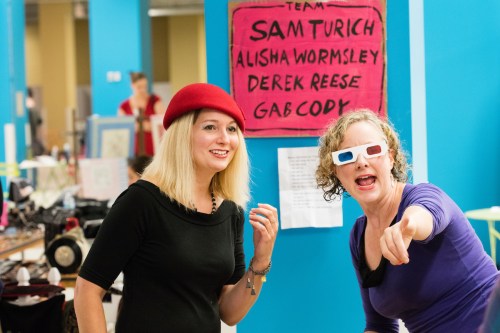
Event judge Gwen Bowman observes the theatrical developments of Gab Cody and “Team Trebuchet.”

Artist T.Foley, a participant in first Art Olympics of 2007, provides a personal account of her time in the Art Olympic arena.

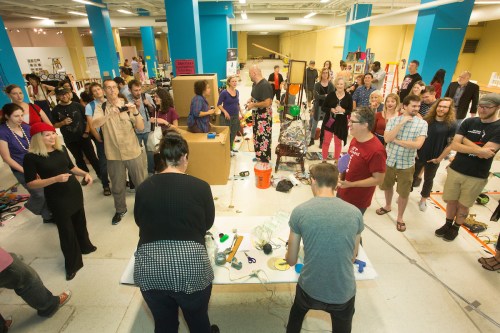
Activity branched out well beyond the team nine foot by nine foot spaces.

The crowd awaits the winner of the puppet making contest.

An audience member provided feedback on the work in progress.
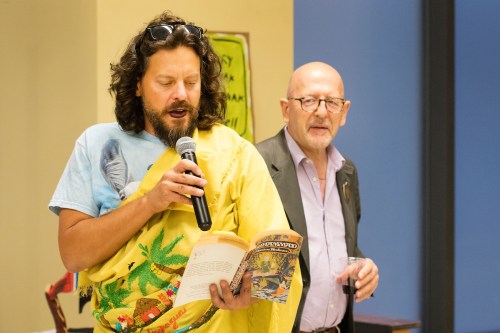
“Team Trebuchet” arrived with their brown paper bag filled with books. Here team leader Sam Turich reads as judge Graham Shearing looks on.
Team “Our Powers Combined” invited audience members into their square to MAKE ART.
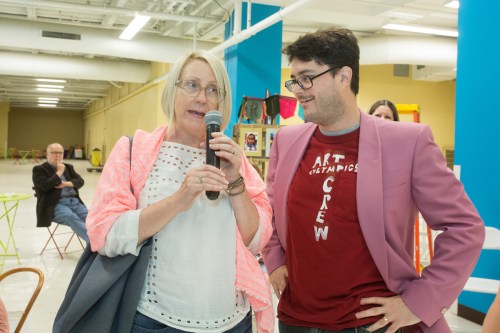
It’s going to be an interdisciplinary arts showdown on Saturday September 17th in Downtown Pittsburgh as three teams of Pittsburgh artists representing a wide range of creative practices face off in a two-hour art-making challenge. Art Olympics begins with an opening ceremony at 6 PM at the Re:NEW Festival’s 623 Smithfield Street location. The teams will begin building at 6:30 PM and work for two hours. The winning team will be announced just before 9 PM. The event is free and open to the public.
The Teams:
Team leader Sam Turich has a background in film and theater. He will be joined by teammates Alisha Wormsley, Derek Reese and Gab Cody. Team leader Ryder Henry is a painter and visionary model builder. His team includes Kate Bechak, Jen Bechak and Nick Falwell. Team leader Audra Clayton is a clay artist / educator. Her team will include Ryan McCormick, Christopher Wright and Kara Zuzu.
The Judges:
Judges will include art critic Graham Shearing, Gwen Bowman of Pittsburgh Puppet Works, artist Travis Mitzel and Diana Shark of Goodwill Industries.
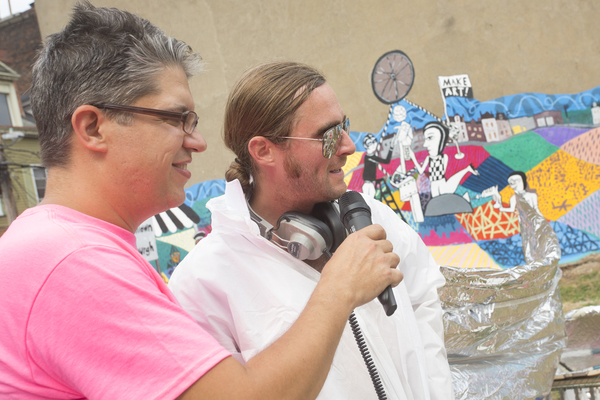
Emcees for the event are Tom Sarver and Mike Cuccaro, with deejay Dave Zak spinning the tunes.
Filed under Uncategorized
This September brings a new festival to Pittsburgh. The Re:NEW Festival celebrates creative reuse, with a monthlong line-up of exhibitions, performances, educational activities and events throughout Downtown Pittsburgh and surrounding areas. A highlight of Re:NEW is the North American premier of Drap-Art, an international show of art made from repurposed materials.
Re:NEW is the perfect venue for Art Olympics, my game-show style performance project that involves teams making sculptural works out of piles of junk over a two-hour period. Goodwill Industries is sponsoring the event, so teams will discover a plethora of old wooden furniture and well-used housewares as their building materials are unveiled.

2015 Art Olympics (Larry Rippel Photograph). The September 17th event will take place in a repurposed retail store in Downtown Pittsburgh.
Art Olympics will take place on Saturday, September 17th from 6:00 PM to 9:00 PM at 623 Liberty Avenue, Downtown Pittsburgh. The show will be free to the public. Stay tuned for more information about teams, judges, and audience activities.
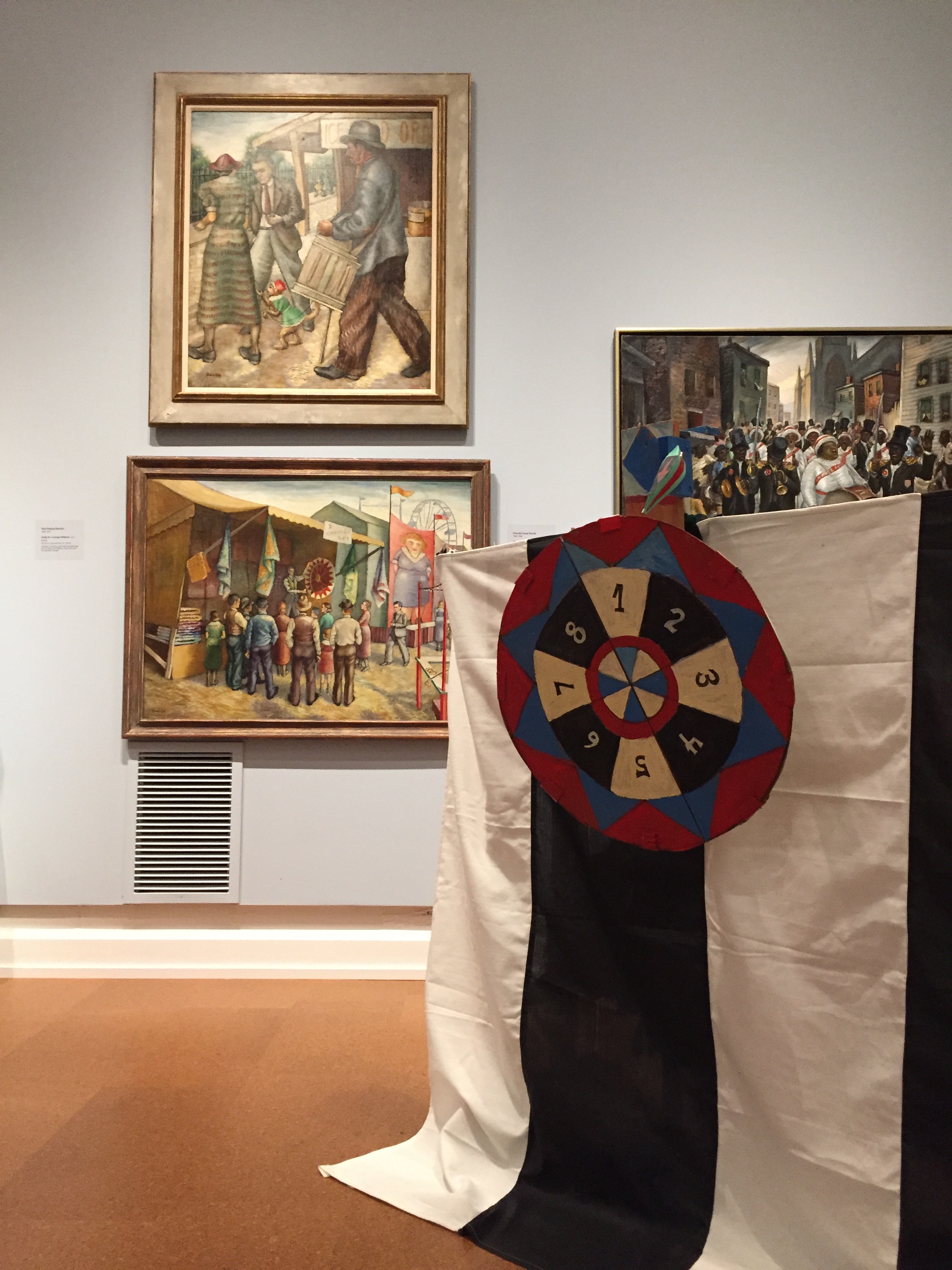
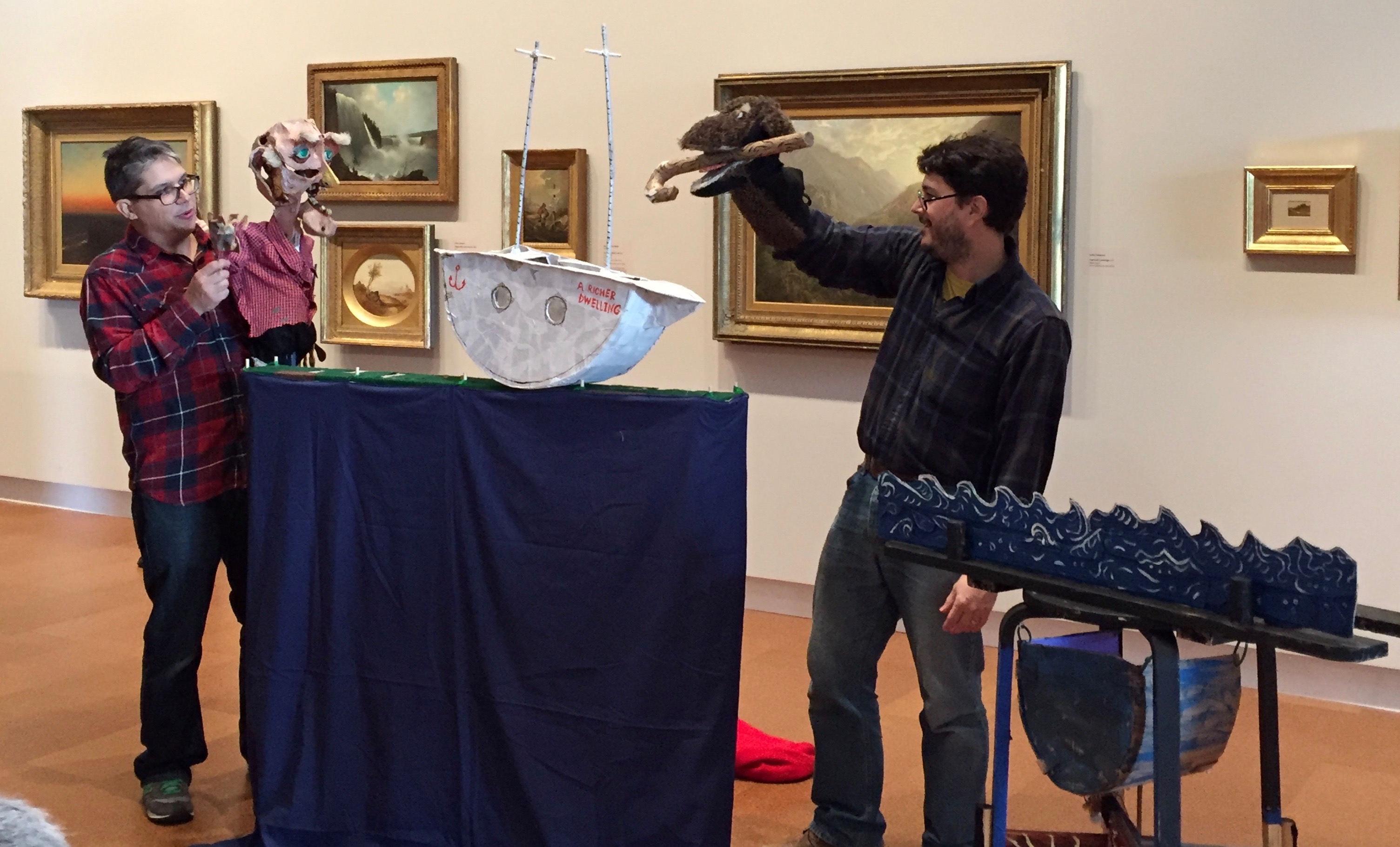
The Westmoreland Museum of American Art, located in Downtown Greensburg, Pennsylvania opened its spectacular, newly renovated museum to the public on Sunday, October 25th, 2015. The Westmoreland has nearly doubled its exhibition space, part of which is a massive cantilever wing walled with windows at its farthest end. The museum has a great variety of historical painting, folk art, bronze sculpture and work by self-taught artists. Mike Cuccaro and I were commissioned to create a series of four puppet shows inspired by the museum collection to present at the public opening. The shows were based on the popular Washington Irving character Rip Van Winkle, featured in a prominent museum oil paining by George Frederick Bensell. Shows happened in four separate galleries of the museum. The first show reviewed the Irving story and imaged his famous character traveling to destinations pictured in museum works. The second show is set in a steel mill, with Van Winkle meeting the millworker Mike Kessel, pictured in a painting by Francis Komperda. The third work is inspired by the carnival paintings at the museum, specifically Carnival at the County Fair, by Dorothy Lauer Davids (1939). Puppets and set for the third piece featured carnival goers, carnival workers and a working wheel of fortune for audience members to spin. The final show happened in the ship-like cantilever wing of the museum. Titled A Nautical Adventure, it was a final furthering of the Van Winkle story, with Rip and his sidekick Cubby the dog setting setting sail for a journey of fishing and exploration.
Filed under Uncategorized
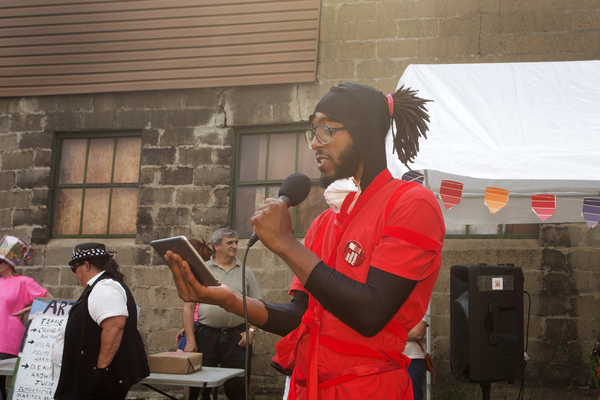
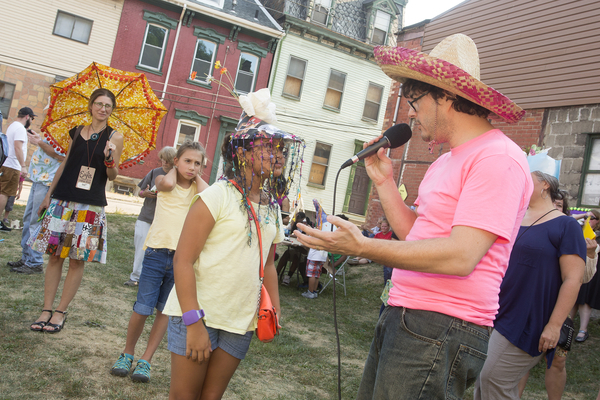
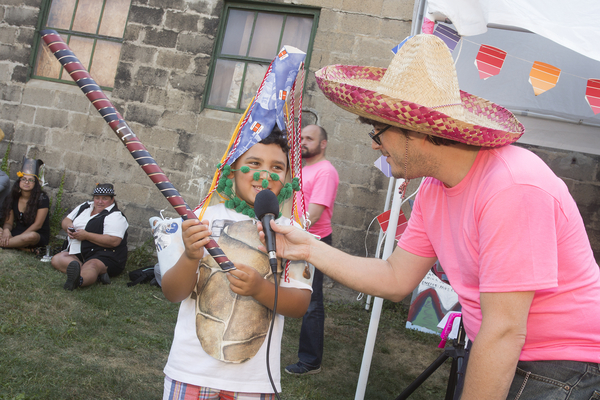
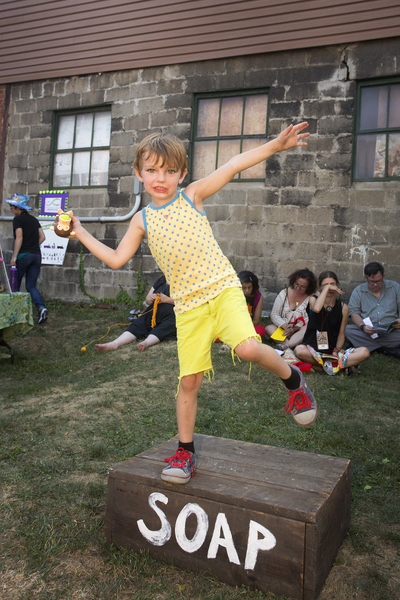
Here is a portfolio of images from the August 29th Art Olympic Festival by Pittsburgh photographer Larry Rippel. Images Copyright 2015.

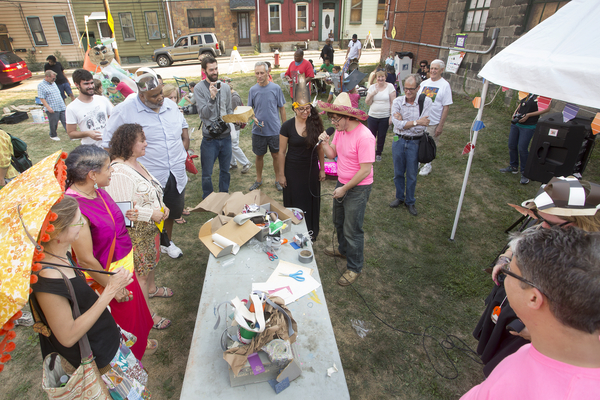
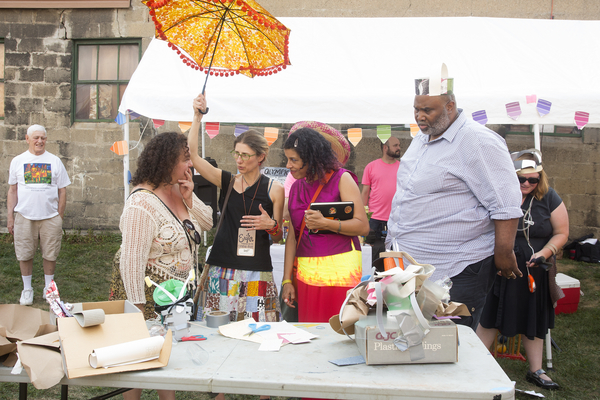
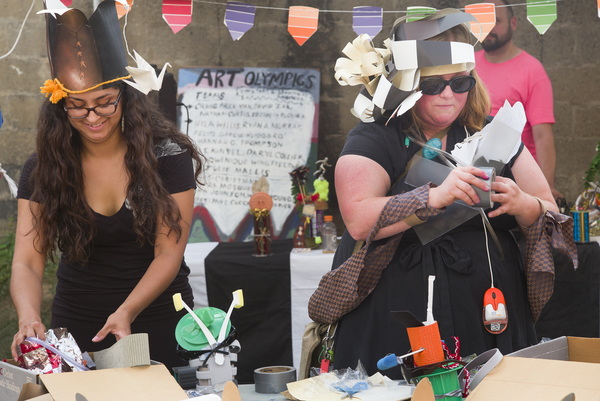
Laura Ramie from Pittsburgh Center for Creative Reuse and volunteer Amy Masters ran the hat making activity.

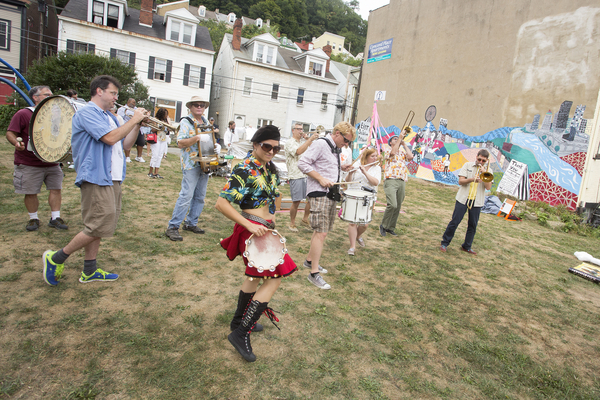
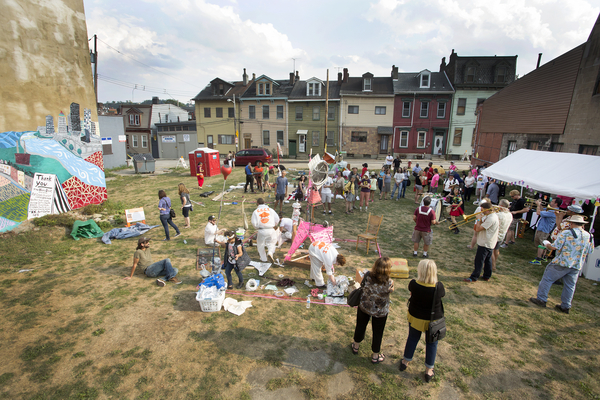
Teams parade from the Neu Kirche Contemporary Art Center to Art Olympic Field accompanied by Colonel Eagleburger’s Highstepping Goodtime Band.

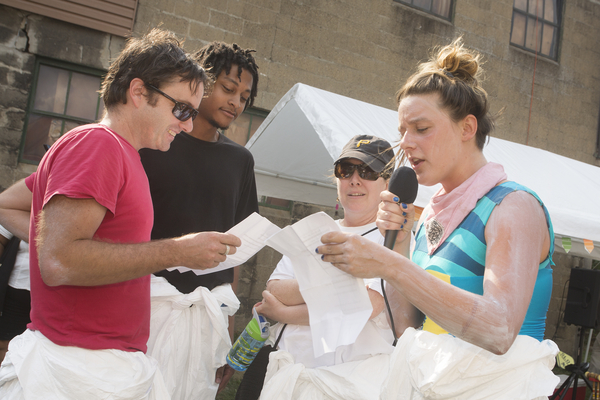
Felipe Garcia-Huidobro, Ryan A. Murray, Hyla Willis and Hannah G. Thompson deliver a team manifesto.

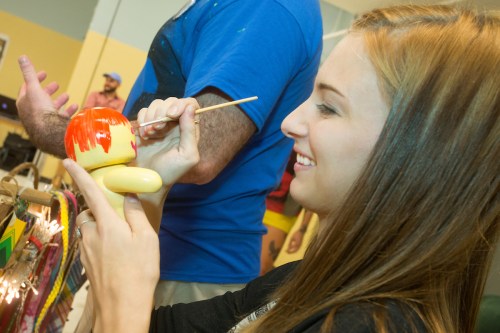
Mike Cuccaro moderates the “halftime show.” Two audience members had seven minutes to create sculptures out of the contents of small boxes. Boxes were filled with random items from Pittsburgh Center for Creative Reuse.

Judges Maritza Mosquera, Erika Johnson, Christiane D, and Wayne Younger debate the winner of the halftime show.

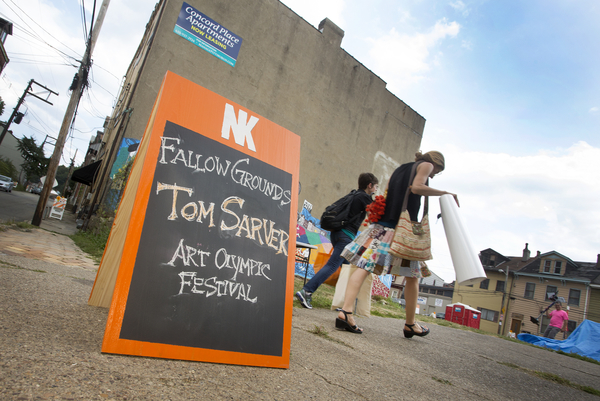
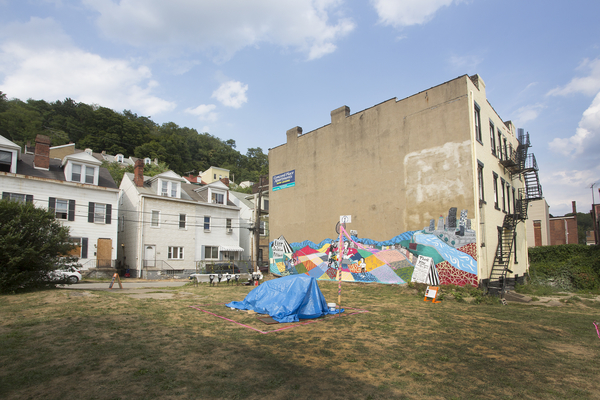
The Art Olympic Festival took place in a rare patch of green space in the East Deutschtown neighborhood of Pittsburgh.
Filed under Uncategorized

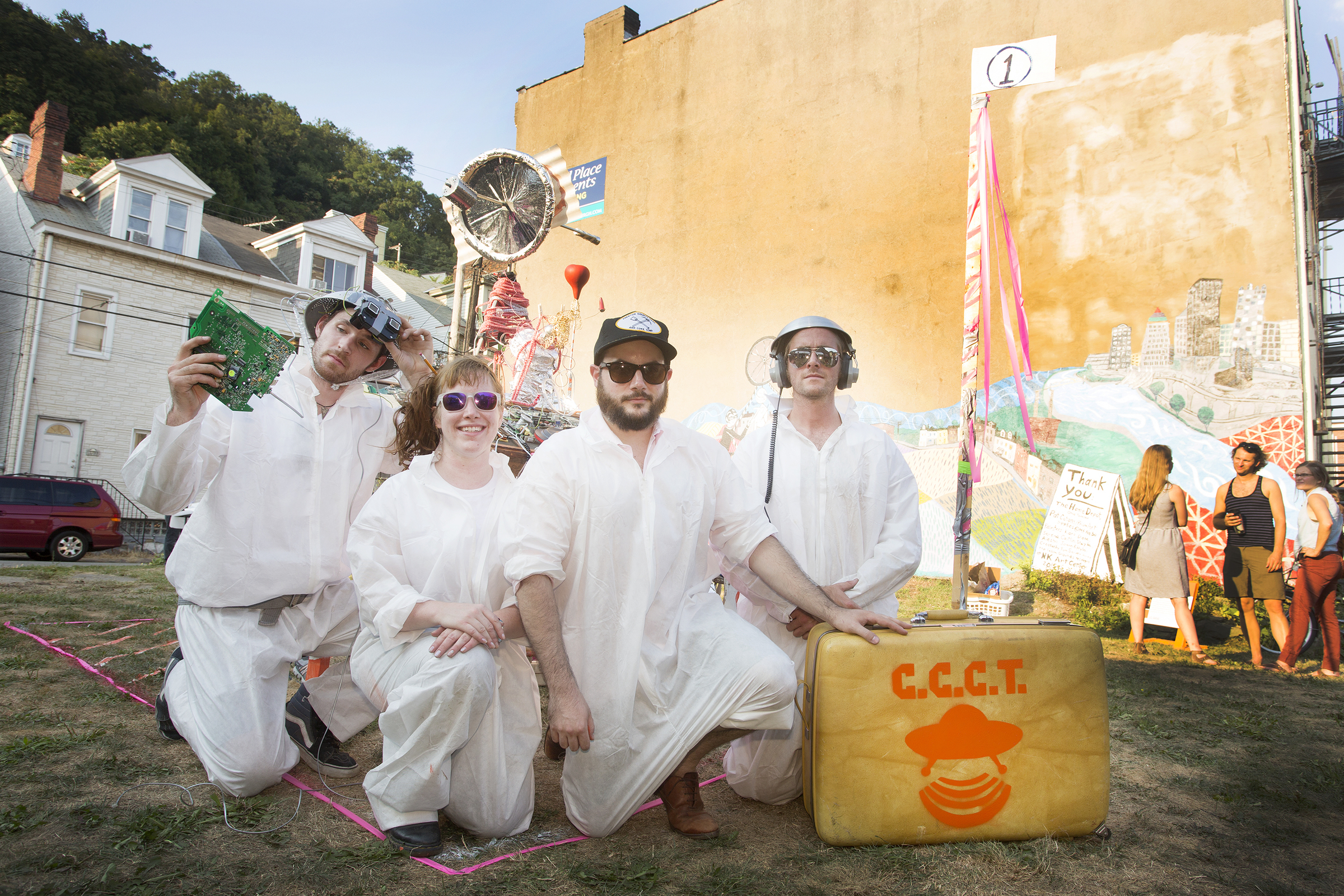
Art Olympics champions Nathan Curtis, Elizabeth Rudnick, David Zak and Craig Freeman. Photo copyright, Larry Rippel.
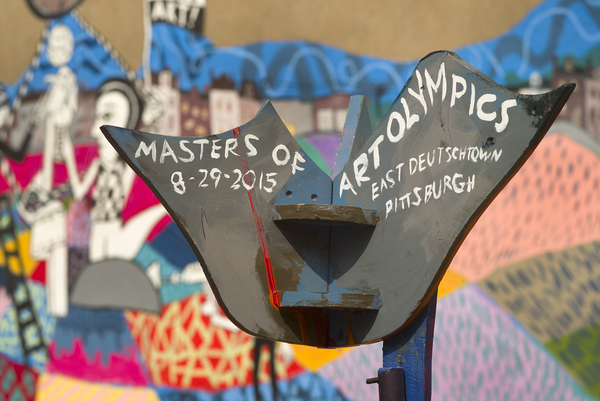
Craig Freeman and team crowned “Masters of 2015 Art Olympics.”
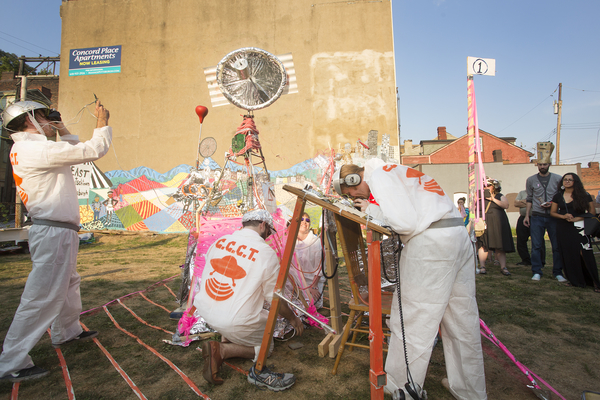
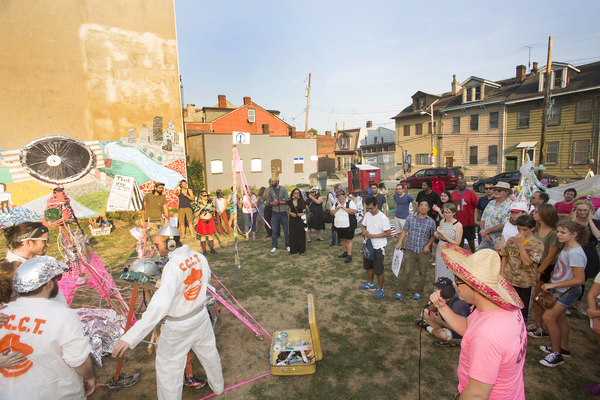
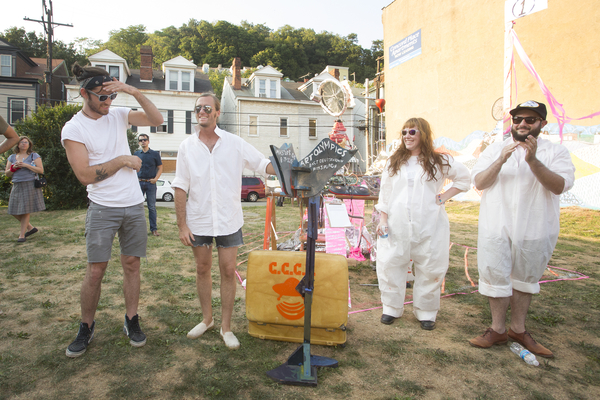
On Saturday, August 29th at 6:30 PM, Artist Craig Freeman and his team, the Commission for Cosmic Craft Transmission, were declared winners at the Art Olympic Festival in East Deutschtown, Pittsburgh. Rounding out Mr. Freeman’s team were artists Elizabeth Rudnick, Nathan Curtis and David Zak. The team members, who are also skilled art installers at some of Pittsburgh’s most prominent galleries, exhibited focus and ingenuity in repurposing the random junk provided for the contest. Their science fiction theme included the use of screen-printed costumes with a flying saucer logo and team abbreviation, C.C.C.T. Their performance involved attempting to contact extraterrestrials with the intention of petitioning for a living wage for Pittsburgh artists. An antenna was raised and their plea was answered by a supportive signal from the beyond.
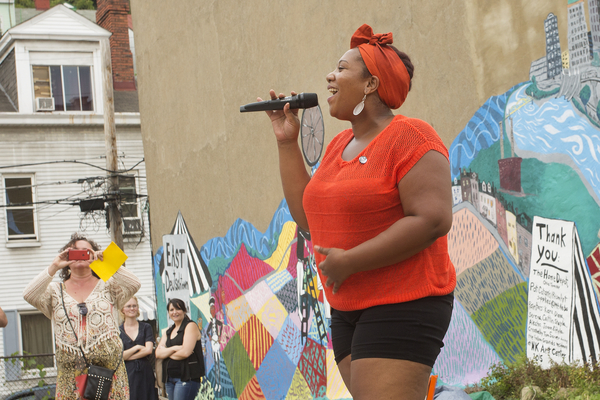
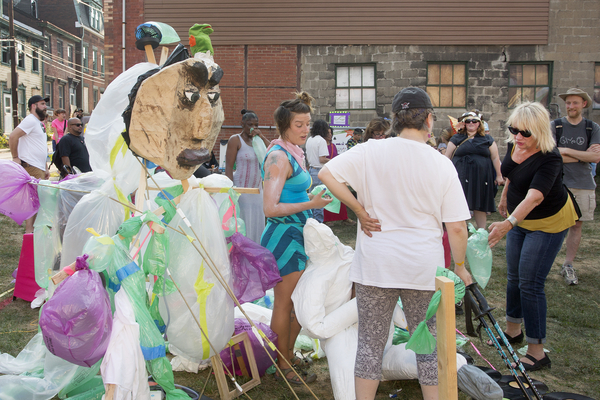
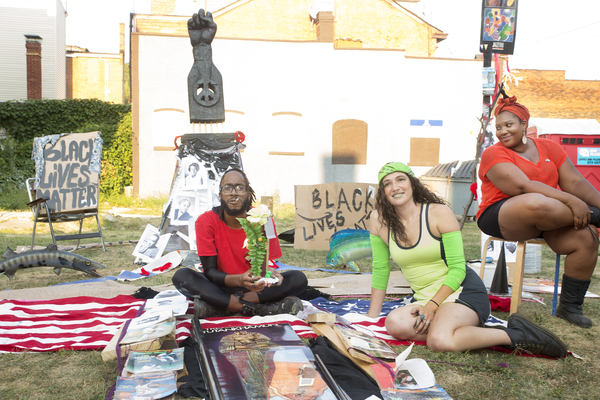
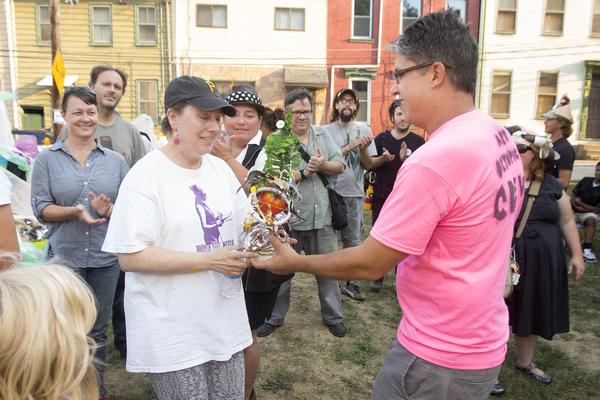
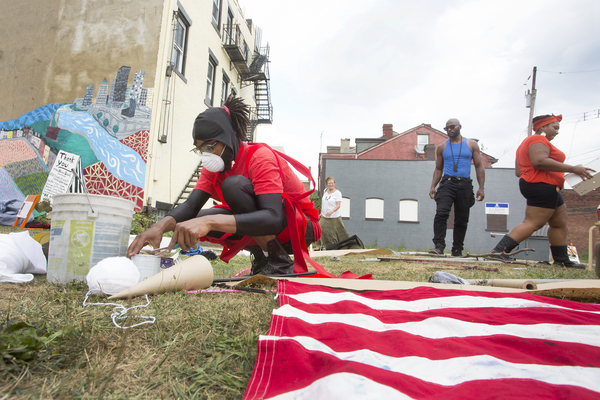
Also exhibiting strong showings at the Olympics were Hyla Willis, with teammates Ryan A. Murray, Felipe Garcia-Huidobro and Hannah G. Thompson and D.S. Kinsel with teammates Daryl Collier, Anqwenique Wingfield and Julie Mallis. Ms. Willis and team invited audience members to participate in the creation of inflated plastic sculptural forms, some of which became props for catching the wind. Mr. Kinsel and his team, representing the Garfield art studio Boom Concepts, explored the Black Lives Matter theme. Their performance culminated in a multidisciplinary display of operatic voice, sculptural form and symbolic gesture.
Judges for the competition included Erika Johnson, Executive Director of Pittsburgh Center For Creative Reuse, multidisciplinary artists Christiane D and Maritza Mosquera and Wayne Younger of Cityview Church. Teams were rated in various categories including: creative use of materials provided, following the rules, adherence to team artist statement, aesthetic quality of the final product, and the performance element during the two-hour long event.
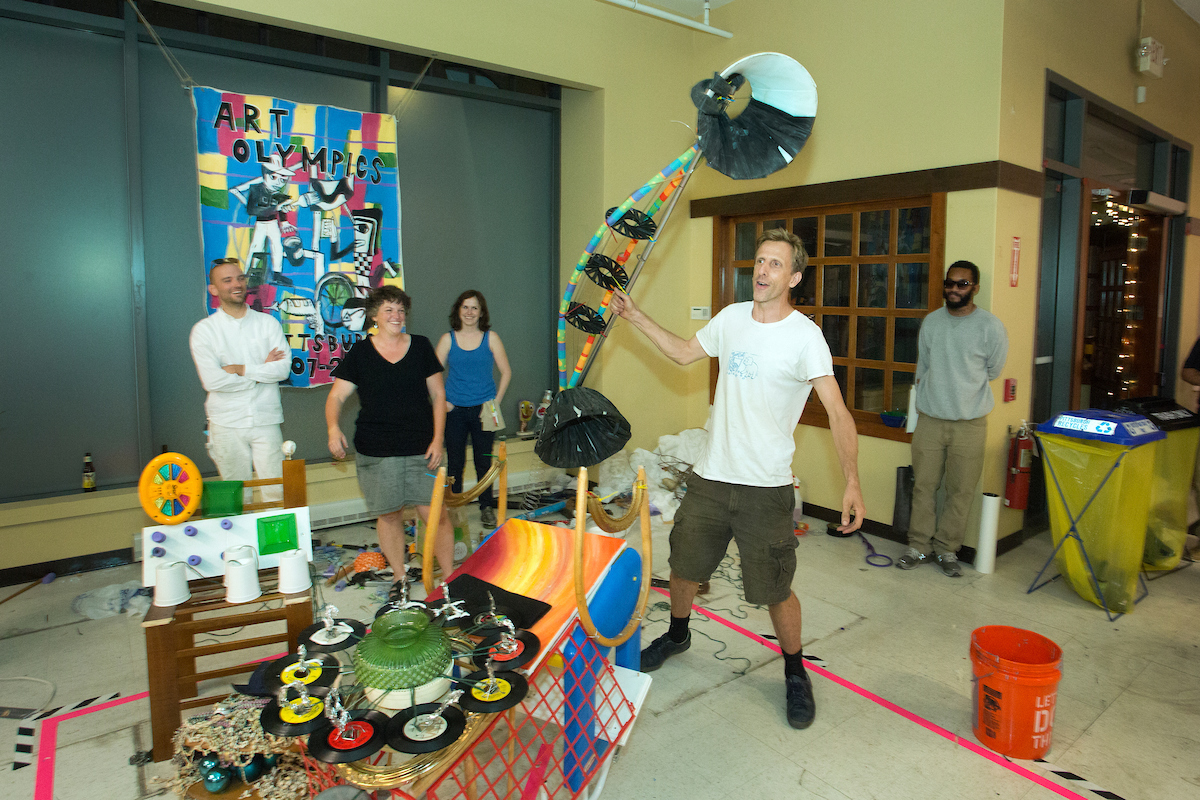
Developed by Pittsburgh artist Tom Sarver, Art Olympics features three teams of Pittsburgh artists competing over two hours to build winning sculptures out of random junk materials. The high-energy, reality TV-inspired event allows visitors to get up close and see the art making in progress. Previous Art Olympic events have been held at the Mattress Factory Museum of Art, the Union Project, Market Square during the Three Rivers Arts Festival, New Hazlett Theater, and Pittsburgh Center for the Arts.