Queasy

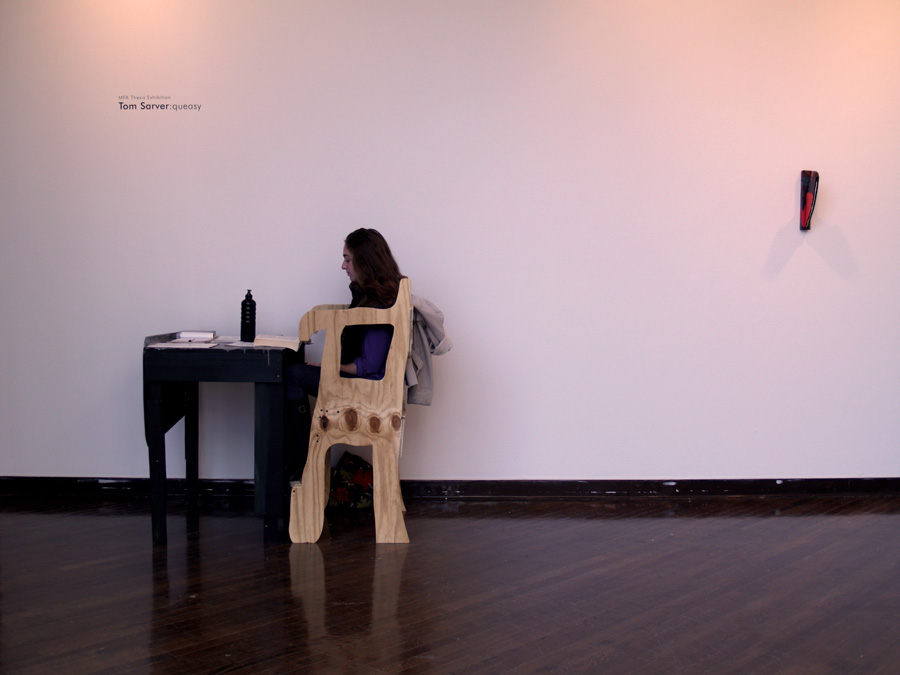
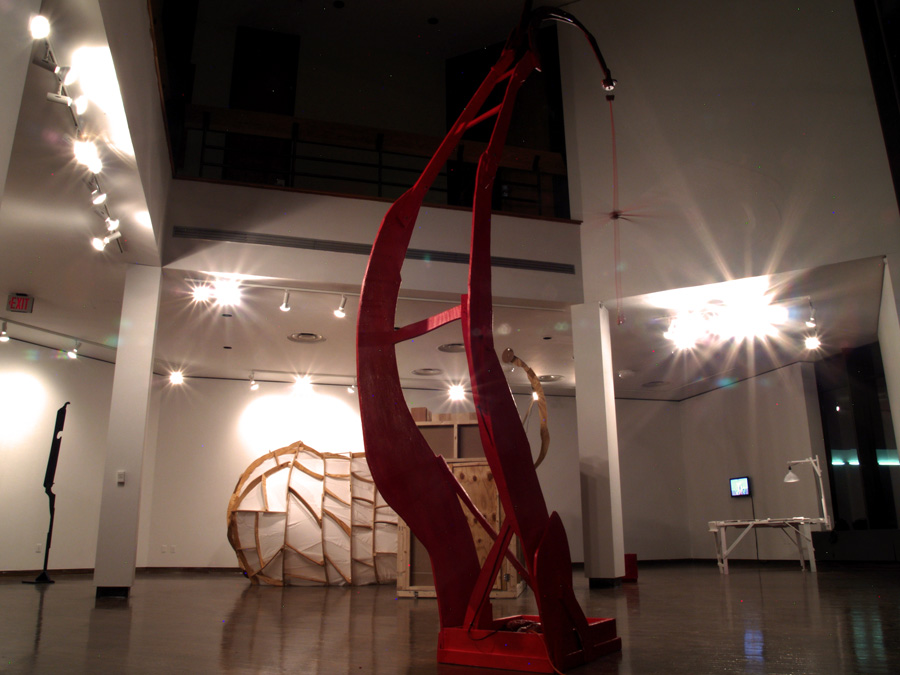
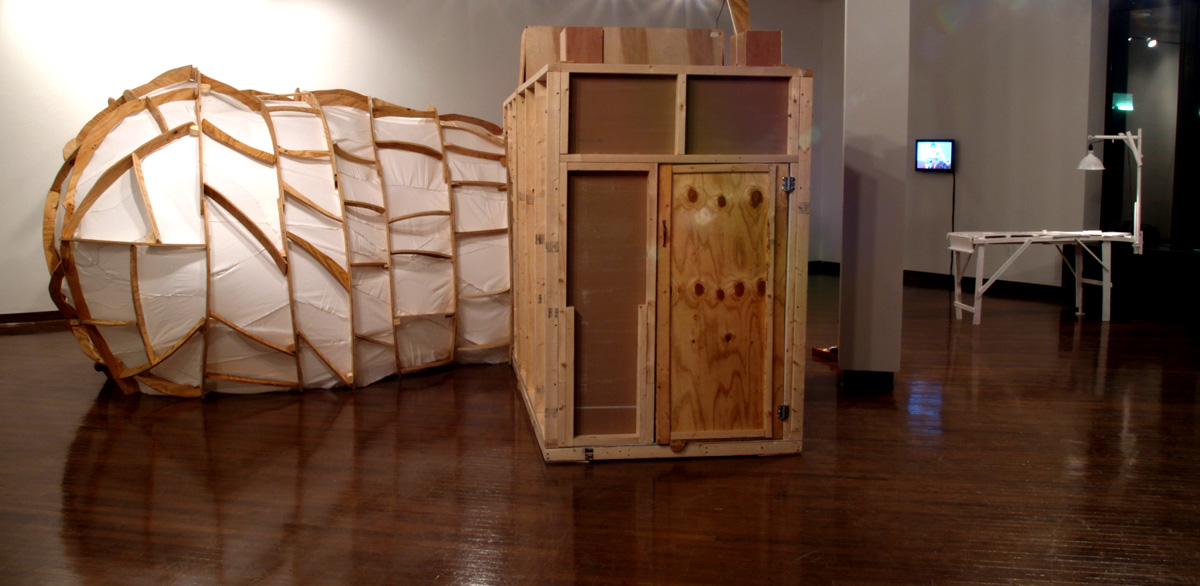
Here are some shots of my solo exhibition at SUNY Purchase College from May 2010.  The title of the show was Queasy.  Within the show, I utilized sound, sculpture, installation and video to explore hypochondria and related anxieties.  In future posts, I will write about how the show was informed by current & ongoing world events.


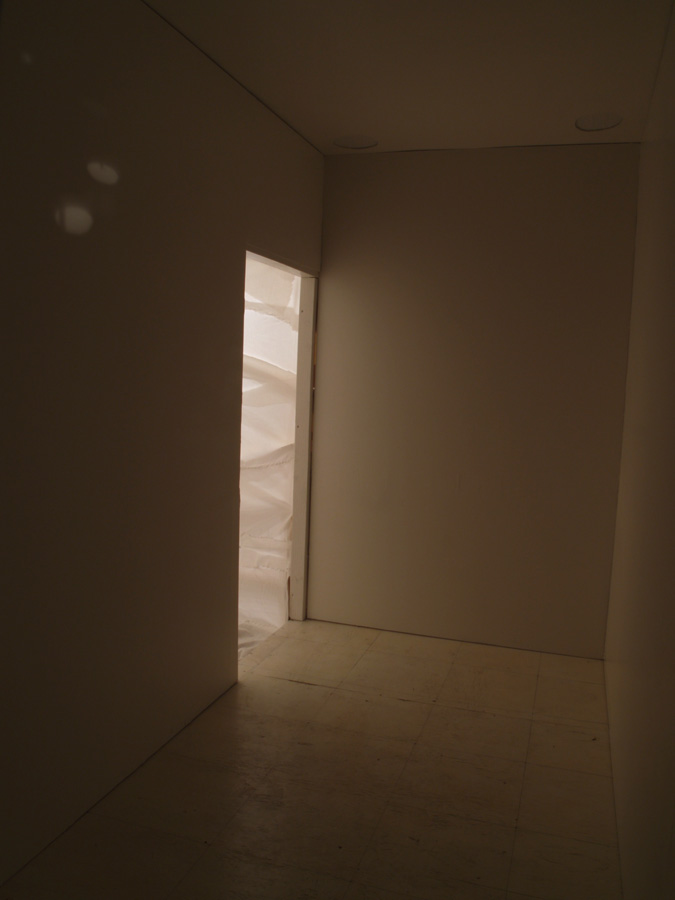
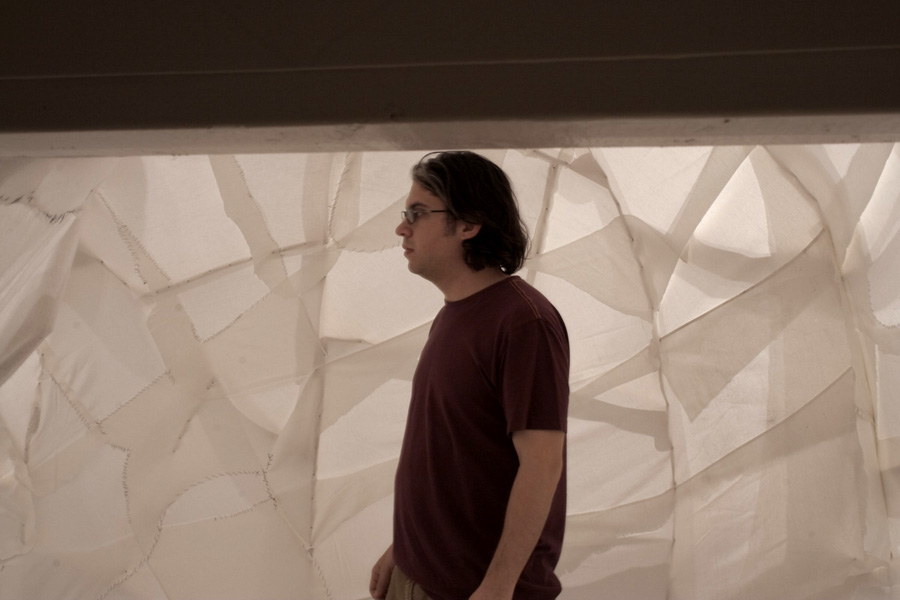
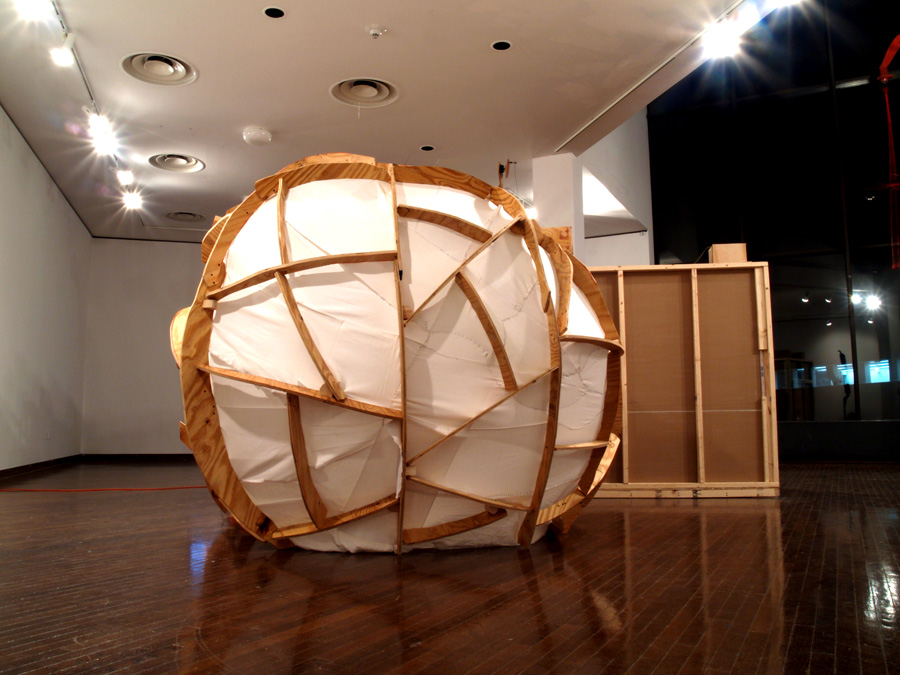
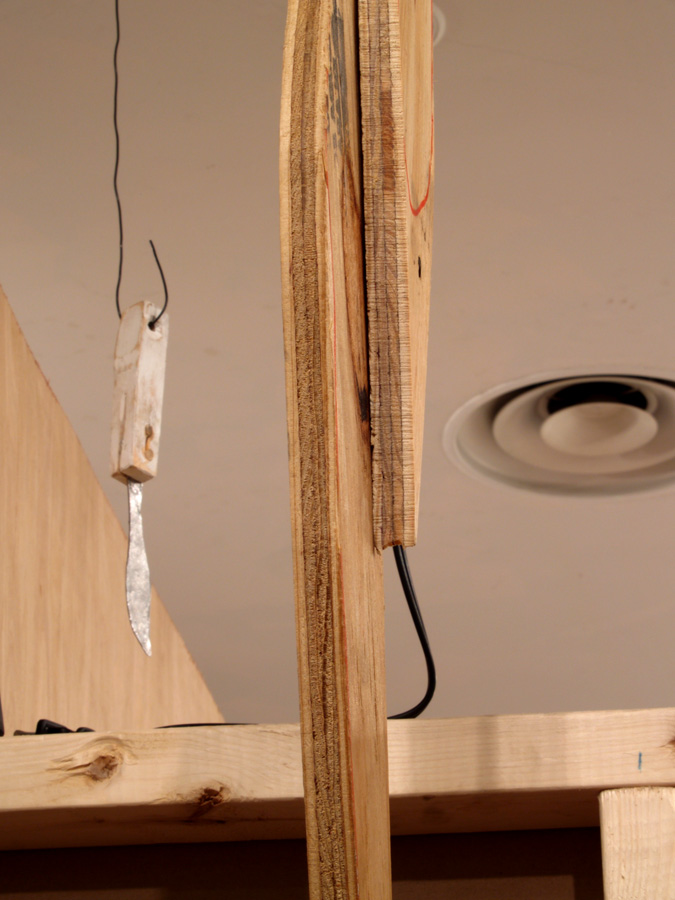
Inside of room.  Shadows on the wall are cast by a hand-forged scalpel blade that dangles in and out of a small hole in the ceiling.  Scalpel (attached to a motor) dips into a hole in the ceiling once a minute, surprising people inside.  Surround sound mix blocks out all outside noise.  Sounds are a mix of nature sounds, industrial sounds, and human vocalizations.  Room is 6ft tall, 12ft long and 4ft wide.  Room leads to a cloth-walled, tumor-shaped enclosure.


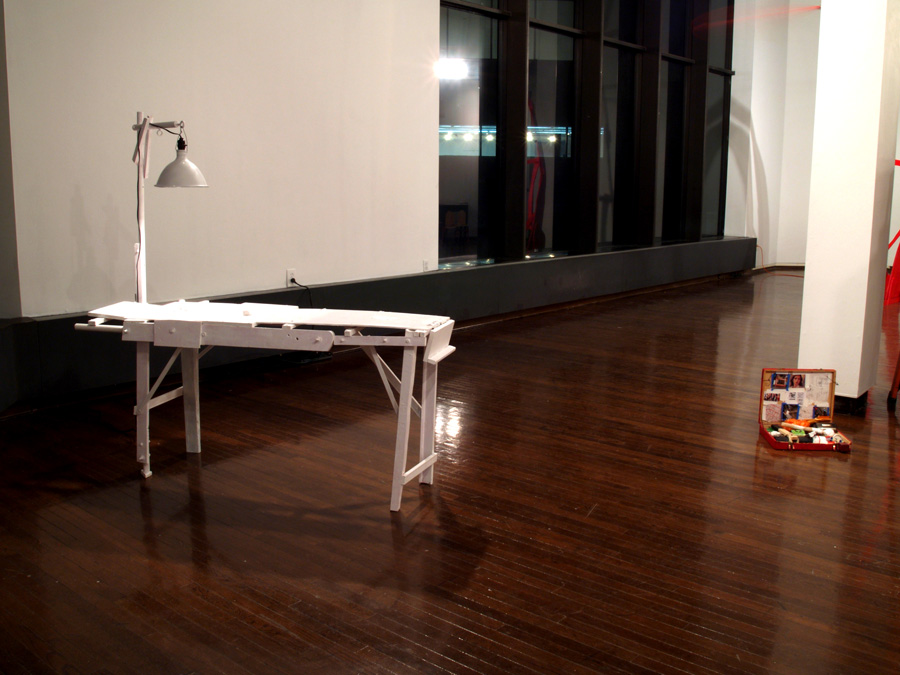
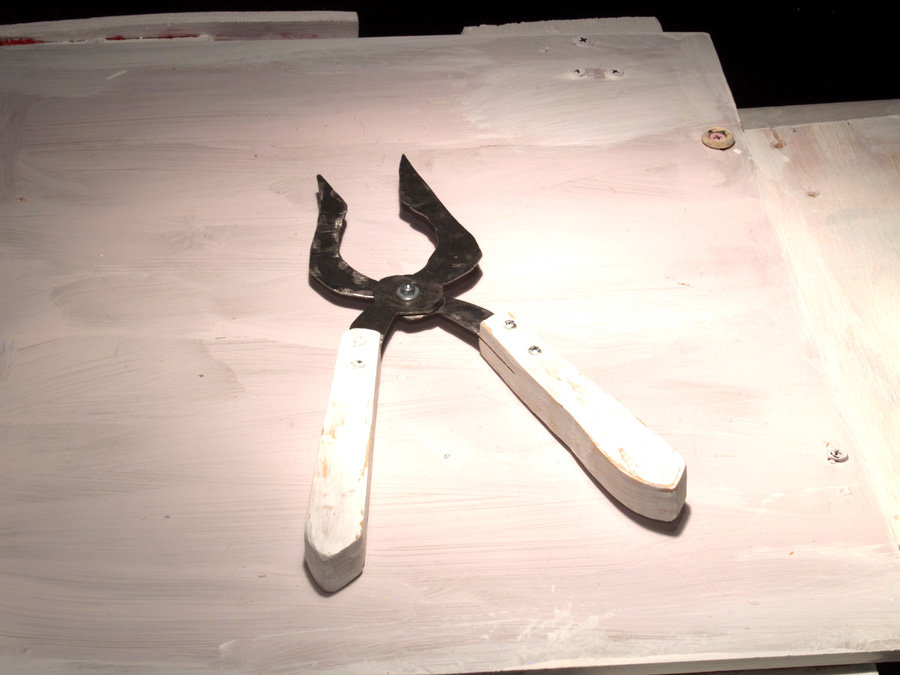
A doctor’s table and survival kit are displaced from the sterile office room.  Table is rickety and unusable.  A hand-made pair of scissors rests on top.  Survival kit contains an odd mix of random items.  A nearby video demonstrates a toxic bath.


1 Comment

Filed under Art

Home on The Toxic Range

Pennsylvania may soon be a toxic mess.

With the election of Tom Corbett as Governor, Pennsylvania is about to be ravaged with a wave of irresponsible and minimally regulated industrialization.  If you stay in the AC, drink imported bottled water, and have all of your food flown in from organic farms, the changes probably will not affect you.  If you like to hike, fish, camp, and explore Pennsylvania’s vast forests and natural areas, you might want to find a new pastime.  Your former getaway may soon be a toxic mess.  You might also want to keep an eye on locally produced foods and your drinking water supply, unless you can handle hazardous chemicals in your system.

Industrialization can be a good thing.  Many of the small towns in rural Pennsylvania appear to be dead or dying.  New industry may revive these historic places.  On the flip side, the temporary boon could plunder the remaining small town culture and create ghost towns.

Outdoor recreation may be Pennsylvania’s largest sustainable industry.  It is not as profitable as natural gas, but it can continue indefinitely if people take care of the environment.  Most of Pennsylvania’s natural areas have undergone substantial remediation efforts over the past eighty years.  Many streams now hold populations of native brook trout.  (The PA state fish.)  Brook trout can only survive in streams with balanced ecosystems, including healthy aquatic life, shade, and cool, clean water.

The new gas extraction methods in PA require a tremendous amount of water.  In order for the operations to be profitable, water needs to be drawn from nearby streams, rivers, lakes and municipal reservoirs!   The companies take what they need; draining some streams dry and destroying delicate ecosystems.  After the drilling the waste water is extremely toxic.  Usually the water is allowed to evaporate in open pits next to the drill pads.  In some cases it is dumped back into rivers.

In August the Pittsburgh Post-Gazette announced that hazardous chemicals leftover from Marcellus Shale gas well drilling are being dumped –with minimal treatment – into the Monongahela River near Pittsburgh.  Apparently, there is some speculation about weather the chemicals can cause ill health to people.

I cannot recall a case where hazardous chemical contamination was a benefit to people, even in small quantities.  Logically, I cannot figure out how hazardous chemicals can be removed from waste at municipal water treatment facilities if waste fluids contain secret formulas developed and patented by the industry.  The bottom line – we have no idea what kind of hazardous chemicals are being dumped into our rivers.  If you put two and two together, you will realize that this waste may jeopardize potable water supplied to our homes, workplaces and schools.  If the chemicals cannot be removed before the waste is dumped into the rivers, then how will our utility companies remove them?  It is true that our tap water goes through a thorough filtration process, but how can our treatment plants filter out new high-tech chemicals if they have no knowledge of them?  For all we know, we may be ingesting diluted poisons.  If the chemicals were designed to dissolve solid rock hundreds of feet below the surface of the earth, we can’t be talking about Coca-Cola.

Through science, we know that hazardous chemicals in our environment cause cancer, birth defects, and other illnesses.  How many people are we going to put in harm’s way for a temporary supply of fuel?  Is it fair for one group to profit from the Marcellus Shale developments while the greater population is faced with a possibility of long-term suffering?

Sadly, it appears as though the majority of Pennsylvanians want the money now.  They are willing to sacrifice the future of the state for a mad rush of industry and a temporary boon.  Most of the profit will probably go to big business, Wall Street and investors elsewhere.  Slick ad campaigns (Managed by former director of HS) will brainwash people into thinking that they are doing the right thing in unconditionally supporting the gas industry. If the industry is challenged and regulated, perhaps a safer strategy can be discovered.

Media Coverage:

Do gas wells pose health risk? – Pittsburgh Post-Gazette

Sudden death of ecosystem ravages long creek – Pittsburgh Post-Gazette

Anglers concerned about decline in Monongahela River fishing – Pittsburgh Post-Gazette

Mon, upper Delaware on list of “most endangered” rivers in U.S. – Pittsburgh Post-Gazette
Leave a comment

Filed under fishing, Journal

Mad Order

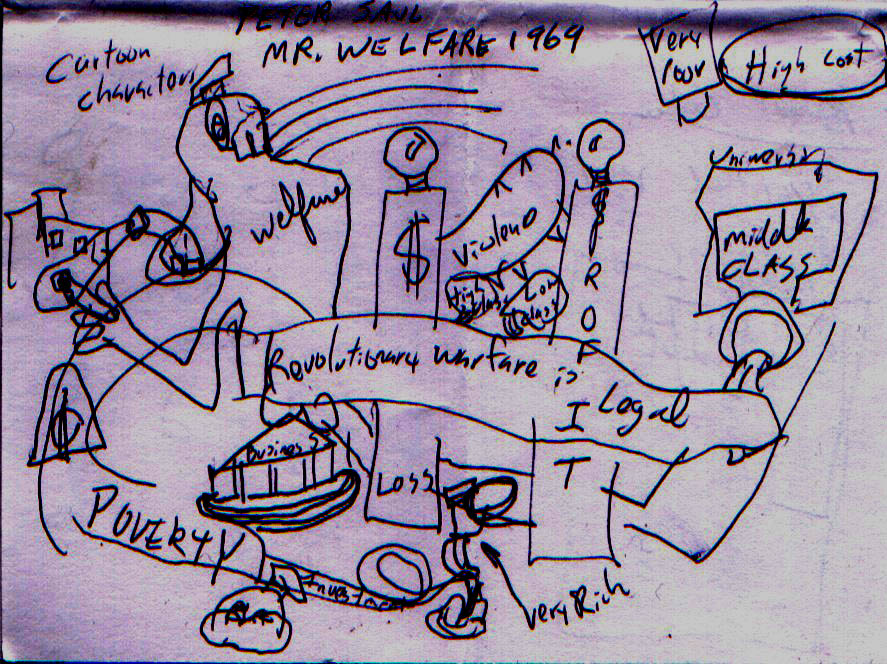
Gallery doodle I made of Saul’s Mr. Welfare.


My thoughts on Ordinary Madness at Carnegie Museum of Art, Pittsburgh

The title of the CMA’s new exhibition is intriguing.  When I heard that the show was being selected from CMA’s permanent collection, I wondered what surprises might be revealed.  In the current economic climate, many museums have resorted to rounding out their exhibition seasons with shows of works from their permanent collections.  Some museums have mixed it up by handing artists the curatorial keys to the city.  Some stick with standard themes like “works on paper” or “video art.”  In Ordinary Madness, I was expecting interesting twists, both subtle and grandiose.  What I discovered was a pretty conservative display of works that range from spectacular to snooze inducing.

At first walk through, the show seems to offer an interesting mix of contemporary work. I believe that many of the works represent specific innovations and should be on display ALL OF THE TIME.  In his exhibition essay, curator Dan Byers organizes works into groups based on theoretical approaches. (Altering the familiar, junk assemblage, historical commentary, etc.) For me, these groupings were not clearly evident.  I explored the show thinking about each piece in relation to the show title and made my own connections.  A lot of time and labor was obviously put into curation.  I see the efforts as heavily educational rather than aesthetic.  The green screen-printed wall labels (in typewriter font) are unique, but they distract from the work.  I also felt like some of the wall explanations are going a bit far in feeding opinions to the viewer.  Isn’t visiting the museum supposed to be a subjective experience?

One of my favorite pieces is Robert Gober’s untitled newspaper piece.  It appears to be a slightly altered printing of a newspaper page containing a multitude of equally strange stories.  One article pretentiously announces the marriage of a well-to-do New York diamond buyer.  An adjacent article describes the horrors of a girl who has been locked for years in a dirty closet.  The piece serves as a reminder of the odd juxtapositions that are so common, but barely noticed in our daily lives.  The other Gober in the show is the drain piece.  The fact that this piece has been moved repeatedly throughout the museum is killing me.  The piece was a perfect site-specific work.  It shouldn’t be tossed around like a painting.  It should live somewhere where its “realness” can play with the minds of museum visitors.  It shouldn’t have a big label next to it.  The beauty of the piece is that everything in proximity is forced to relate to it.  It should be a familiar museum landmark to some, and a piece of museum plumbing to others.

Rarely seen in the galleries, Peter Saul’s Mr. Welfare (1969) is another gem in the collection. I get the impression that the piece has been censored from permanent display because of its perverse content.  The piece is so jarring that it needs a ton of breathing room.  At one time I think it lived where the Warhol phone piece currently resides.  Perhaps they should put it back and display the phone in the lobby.

Other high points of the show are pioneering video art pieces including works by Peter Campus, Lynda Benglis and Vito Acconci.  Viewed today, the artists in these raw and distorted pieces appear as inhabitants of a distant planet.  I was also excited to see collage works by John Bock, and sculpture by Mike Kelley.

All in all, I would have preferred fewer pieces and a more thoughtful arrangement in Ordinary Madness.  The sound overlap from three of the video pieces (At the back end of the show) made it nearly impossible to focus on the Oursler piece.  Anne Chu’s Nine Hellish Spirits: No. 2 is awkwardly crowded against a wall.  In a public venue I understand that work must be displayed in a manner that prevents damage and ensures a safe environment for visitors.  As a critic, I want to see the work displayed in the best way possible.  Can we have it both ways?

Leave a comment

Filed under Art, Criticism

Life in the Big Cities

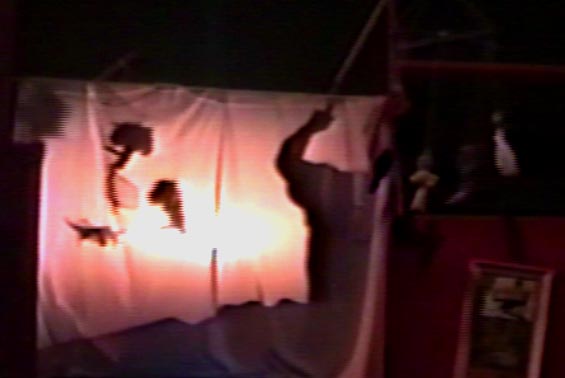
1999 – Twelve years ago in Pittsburgh.  I was as knowledgeable about puppetry as I as was about mechanical engineering.  For the first Black Sheep Puppet Festival, I built life-sized puppets out of inch-thick plywood.  Music was a mix of Sonic Youth, Pixies, Talking Heads and contemporary jazz samples that I captured with a tape recorder.  The only smart move was making the giant snake out of foam core.  The plot was ridiculous.  (Most likely comparable to an episode of Beverly Hills 90210)  The following year, I found help in recording original music.  Puppets evolved into lightweight creatures with movable parts.  The plots became more complex.

I recently converted my documentation of the show. (from VHS!)  Above are a few stills.

4 Comments

Filed under Puppets

Halloween Pittsburgh

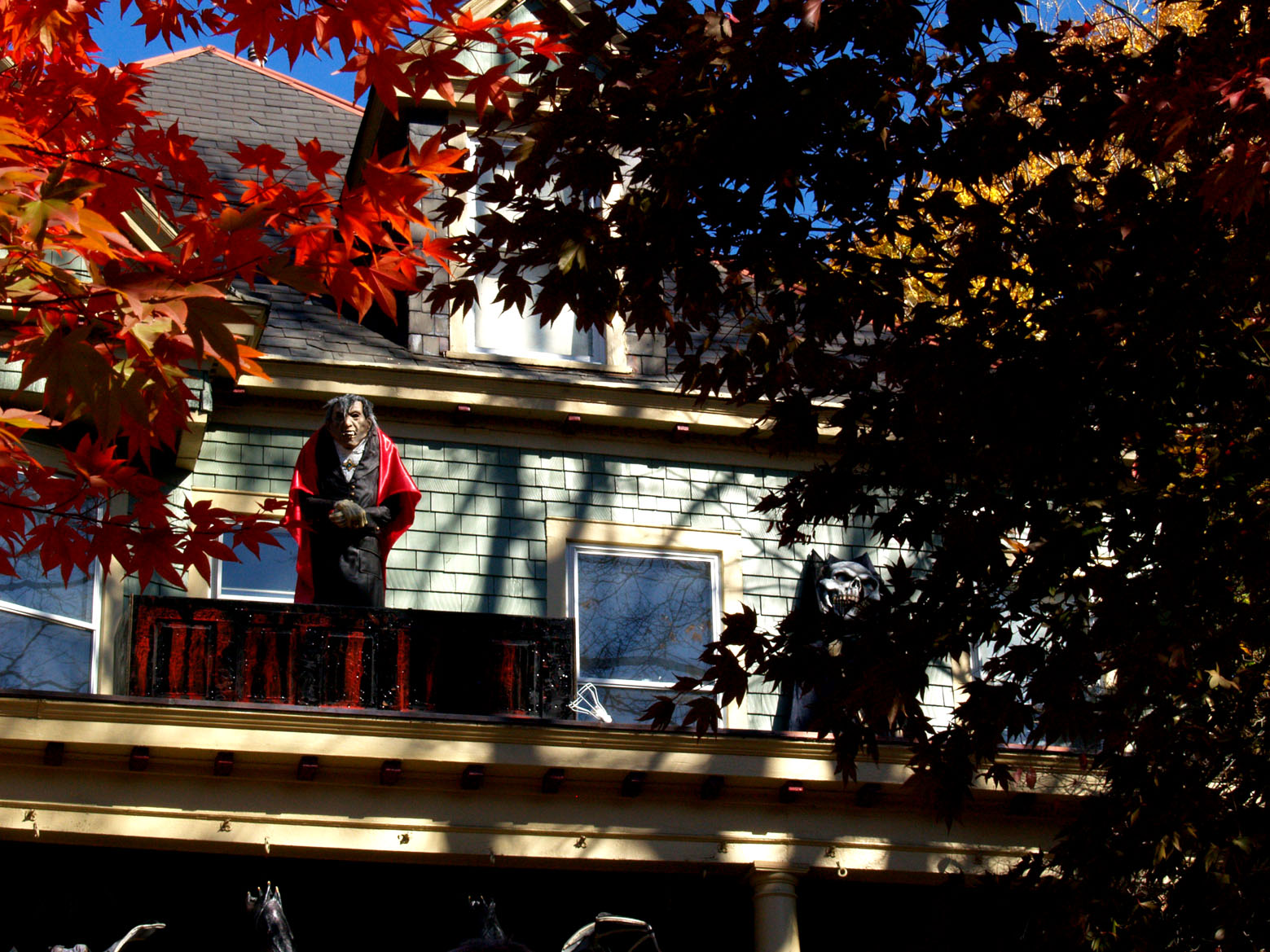
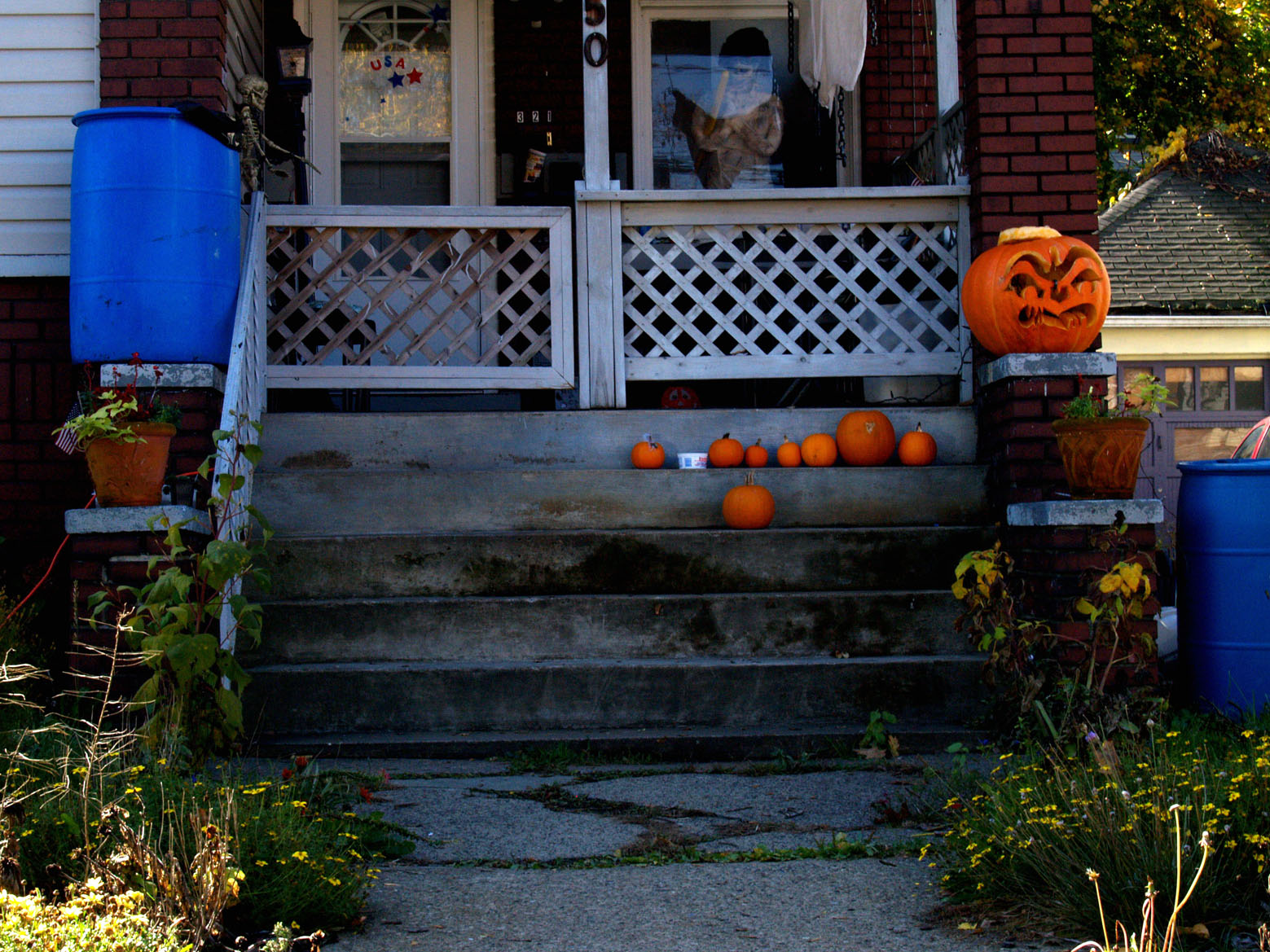
I drove around the Ohio River Valley this morning with my sister looking for Halloween weirdness.  Most people nowadays buy cheap, generic decorations at the big box store.  Here are a few of the better arrangements.

Leave a comment

Filed under Journal

Queloides at Mattress Factory

Review of Queloides, Part 1

It’s exciting to see a new Cuban show at the MF, especially one that explores race and racism.  Cuba is a country with a complex set of issues.  Cuban Americans that I have spoken to have been reluctant to talk about their experiences.  In a land where family members are often torn apart by politics, I can’t imagine the magnitude of racism on the island.  My immediate thoughts before visiting the show revolved around the opportunity the MF has with this exhibition to address race and racism in their neighborhood.  Having lived on the North Side of Pittsburgh for a couple years, I saw firsthand the tensions caused by the rapid gentrification of the community.

The exhibition spans both of the museum buildings including some work outside.  My favorite two pieces are the car (Armando Mariño) in the parking lot* – a near mint condition antique Plymouth with ceramic legs of twelve or so Afro-Cubans holding up, and potentially powering the car – and the shrine in the basement of the main building.  The later, a shrine of roughly sixty statues of La Virgen de la Caridad del Cobre, patron saint of Cuba stand in a variety that ranges from cheap knickknack to finely crafted folk art.  The statues have an iconography specific to Cuban legend, (Involving two men and a slave boy finding the original Virgin statue while in a boat at sea.)  Around an island-like platform supporting the sculptures, A quote from nineteenth century Cuban hero José Martí reads, “Either the Republic is based upon the full character of each and every one of its sons and daughters (….) or the republic is not worth a teardrop from our women or a single drop of blood by our brave fighters.” Martí fought for Cuban independence from Spain.  I believe his quote in the context of the installation alludes to a national solidarity perpetuated by the belief in a power greater than the ruling regime.  The installation, by Meira Marrero and José Toirac, demands reverence as it perfectly occupies the grotto-like basement of the building.

Upstairs, the next piece that I encountered is Alexis Esquivel’s Automatic Vehicle to Collect Religious Offerings.  I was expecting a bit more edge in the show, not whimsical sarcasm, so I didn’t care for this one.  It was supposed to be an interactive piece, allowing the visitor to operate a remote controlled model street sweeper of sorts.  (Or perhaps its dysfunction is part of the commentary.)  Esquivel’s strength is in painting.  Several large works comment on the “whiteness” of American politics as well as the supremacy of America in the Western Hemisphere. His content ranges from obvious to mysteriously symbolic.  His style is a collage of political and personal imagery.

The work of Maria Magdalena Campos-Pons reminds me of the Cuban art that I have seen, especially the work of Tania Bruguera.  (Who does some amazing work and is strangely accepted by the Castro regime.) Like Bruguera, Capos-Pons utilizes symbolic elements of the earth (sugar blocks) to create rich, sensory experiences.  The piece, two walls of raw sugar bricks narrowing with a pile of refined sugar at the end, immediately reads as feminist art. An accompanying video features communication between a white woman and a black woman.  I wasn’t too interested in this piece, but the thought of licking the sugar blocks when nobody was looking was tempting.

I spent a lot of time looking at the mural sized painting of Douglas Pérez.  I wasn’t that excited about it at first, but it grew on me.  Pérez has his own style.  He layers allegorical imagery, arranging characters in a cycle of power and oppression.  The piece addresses poverty, the struggle of the worker, corporate influence, greed and death in a grotesque, highly detailed manner.  (Bosch meets Darger) A skeletal snake creature devours a giant centipede. (Or vice versa)  Each creature is made up of people involved in the struggle.  The work is titled, Ecosistema.

There is a lot to see – and a lot to write about – at Queloides.  I’ll continue this review another day.  It’s too nice outside.  I want to take pictures of Halloween zombies on Pittsburgh front porches.

*I just found out from MF staff that the title of the car piece by Armando Mariño is Raft.  The car was procured by the museum for the installation and restored from a “chipped grey matte finish.”  (This is good example of how dedicated the museum is to obtaining the materials that resident artists need for installations.)

Leave a comment

Filed under Art, Criticism

Another look at Snakebird

Planet of Slums ended last weekend at Mason Gross Galleries.  Here are a couple additional shots of my piece, Snakebird.

Darwin’s Nightmare, a documentary film written and directed by Hubert Sauper, was screened as part of the exhibition.  The film paints a clear and disturbing picture of the effects of globalization on Third World communities.  It’s been a few years since I saw the film (at the Three Rivers Film Festival) and I’m still haunted by it.

(see September 29th post)

Leave a comment

Filed under Art

big painting

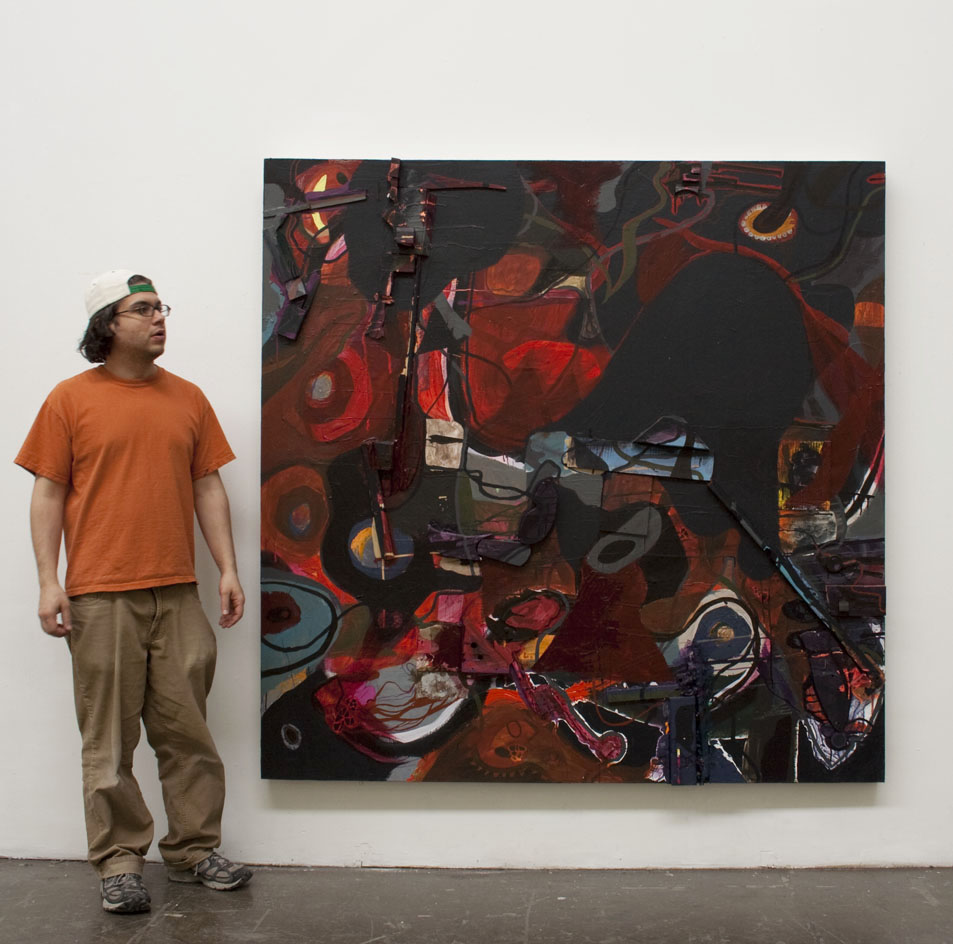
I made this painting in February of this year.  Sometimes I need to make big atmospheric abstractions like this in between conceptual projects.  Thinking in a different way helps me to clear my head.  The decisions in this type of work happen through looking at the work as it evolves.  It is more about color and the properties of paint than making a great philosophical statement or addressing a social issue.  The applications of paint and layers in a work like this can be quite complex.  While I was making it, a couple curators stopped by my studio and looked at me like I was crazy.  Why are you painting?  I guess just needed to at the time.

Leave a comment

Filed under Art

puppets

Puppets / found materials, papier-mâché, paint, wood / October, 2010

Leave a comment

Filed under Art, Puppets

Will Black Sheep Return?

Video from 2nd Black Sheep Puppet Festival, 2000

The Black Sheep Puppet Festival took place from 1999 through 2008 at the Brew House, Pittsburgh.  Puppeteers from across the country converged on the South Side during the month of October for performances, workshops, and impromptu happenings.  Black Sheep introduced Pittsburgh to puppetry with an activist edge.  The collaborative nature of the event made it difficult to compare with anything else in town.  Black Sheep offered a critical view of society, without the pretentious layers of the art world.  It operated as far as it could be directed from the corporate, commercial world.  It was driven by the hard work of organizers, who volunteered hundreds of hours to see it through.

Perhaps the festival will return on a small scale and gradually build up to a city-wide event.

Black Sheep Website

1 Comment

Filed under Art, Puppets